Showing posts with label Afghanistan. Show all posts

Friday, 3 February 2012

The Silk Road overland East to West - Visa strategy

When travelling on the Silk Road in Central Asia is is never long before the conversation between travellers turns to visas. For a successful overland trip a visa strategy has to devised before departure. It is not a region which can be travelled through on a whim. With a little planning visas can, however, be picked up along the way. In this post I will describe how we did it, which we managed without requiring the services of a visa support agency. There are obviously thousands of permutations of how to cobble together all the visas needed for such a trip, but I thought I'd simply write about how we did it - as I think the post is long enough as it is!!

First of all here are some general tips on Central Asian visa planning and execution.

  • Plan exactly when and where you will get each visa.
    • Know how long the visa process takes and then add on more time in case of unexpected embassy closures, like those for public holidays which an embassy will take both for the country the embassy is in and those for the embassy's national holidays.
    • Have plenty of passport photos and photocopies of your passport to hand.
    • Have a good idea of the dates you will be entering and exiting the country, how long you will need a visa for and an address of where you will be staying (any address is fine).
    • Speak the language, take a person who does or, at the very least, take a phrasebook, if applying in person at an embassy.
    • Know how much it is meant to cost. Question any price rises.
  • Overlap your visas by a couple of days. This means that you are not relying on crossing a border on one particular day. Borders are sometimes closed at weekends or on public holidays.
  • Always enquire about an Express Visa Service. Sometimes this doesn't cost any extra.
  • Consider getting multiple entry visas for flexibility.
  • Use forums, such as the Lonely Planet Thorntree, for up to date info and tips, but beware of tips from people who haven't actually done it!!
  • Use Caravanistan's Central Asia visa guide, an up-to-date resource on visas as well as border crossings in the region.
  • Finally, apply flattery liberally, even when you are clearly being obstructed.


Here is a summary of how we got all the visas needed to travel overland from Kathmandu to London. We were travelling on British passports from Nepal westwards through, Tibet, China, Central Asia, across the Caspian Sea to the Southern Caucasus, before entering Turkey and the final stretch through Europe to the UK. All the visas we obtained were single entry tourist visas and obtained in person at an embassy unless otherwise stated. DISCLAIMER: This information may already be out of date!!


Country
Cost
How long for? Number of entries? When does the visa time start?
Obtained where?
Length of visa process
Nepal
$100
3 month
Multiple entry as standard
On arrival at Kathmandu airport
On the spot

Remember to have a passport photo hand in your hand luggage.
Tibet
$37
14 day
Kathmandu agent as part of Tibet tour
On the spot

China
Travelled in mainland China on Tibet Permit. See above.
Kyrgyzstan
£60.00
1 month
(visa starts on specified entry date)
London by post
1 week

Applying for a visa through the Kyrgyz embassy in London was a very simple process. Fill out the online form here and then send your passport and relevant documents to the embassy.
Kyrgyzstan extension
1065 Som
1 month
Multiple entry
(visa starts when previous runs out)
Bishkek, Kyrgyzstan
1 day (submit in morning collect in afternoon of same day)

At the OVIR office we were required to copy by hand a Letter of Invitation, in Russian, which we submitted with an application form and passport photo.
Kazakhstan
Travelled on our Kyrgyz tourist visas. Note you must has a double or multiple entry Kyrgyz visa to be able to re-enter Kyrgyzstan. For more information see A couchsurfing minibreak in Almaty.
Tajikistan
£100
(+£50 for GBAO permit)
2 months
Double entry with GBAO permit
(visa starts on specified entry date)
London by post
1 week

We followed the instructions on the Embassy website here. Together with an application form, our passports, photocopy and photo a travel itinerary was required. We simply wrote a letter with where we planned to be when and this appeared adequate.
Tajikistan Visa registration
135 Somani
Visa registration for a double entry 2 month visa
Khorog, Tajikistan
On the spot

We read that if you have anything more than a 1 month single entry tourist visa you are required to register. We went to the OVIR office and were directed to the neighbouring bank to pay. Returning to the OVIR
Afghanistan
£70.00
1 month
(visa starts on entry which can be any time within the stated 6 month period)
London in person
5 days

The details for applying at the London embassy can be found here. Along with the usual documents the website states that utility bills are required to verify your current address in the UK. When we presented these the embassy said that they now no longer require them instead we needed a letter from our place of study or employer. After a day of frantic phones calls we got the letters and then the application went very smoothly. Hindsight I would have got a visa in Khorog, Tajikistan which takes 1 day.
Uzbekistan
$62
1 month
(visa starts on specified entry date)
Bishkek, Kyrgyzstan
7 days

To get a visa you must phone (in Russian) the embassy the day beforehand and get your name put on a list. Fill out and print off an application form here. The following day take the form, a photo and a copy of your passport to the embassy at 10 am and join the queue. A week later you need to get your name put a list the day before again. Return at 10 am with your passport and the visa is put in your visa then and there. We had a slight problem in that the official wasn't keen to give us a visa more than 3 months before our entry date (it was 3 months and 6 days before our planned entry). Luckily we managed to talk him into doing it for us. Note that a tourist visa (denoted as T on the visa) only allows for the holder to stay in hotels registered to take foreigners. For each stay you are given a registration slips which needs to be retained. We only got asked to show them once, on the Tashkent metro, when we were staying with friends and didn't have any, but we managed to get around this problem, and continue staying with our friends.
Turkmenistan
$85
5 day
TRANSIT
(visa has specified dates and entry point)
Applied for in Dushanbe, Tajikistan
Collected in Tashkent, Uzbekistan

7 days Express service

See Turkmen Visas – a riddle wrapped in an enigma for the long version of this.
Azerbaijan
$101
(I think we might of got scammed on this)
5 day
TRANSIT
(visa specified a months period for travel)
Dushanbe, Tajikistan
On the spot
Georgia
No Visa
3 months


Abkhazia
$10
1 month (specified
Online application.
Pick up in Sukhumi, Abkhazia


Armenia
$10 or 3000AMD
21 days
Georgia/Armenia border crossing by rail


Note that at the current exchange rates it is cheaper to pay in AMD (have the correct change if paying in $)
Nagorno Karabakh
$10
14 days
Yerevan, Armenia
On the spot

For more information see How to obtain a Nagorno Karabakh visa. Remember to register the visa on entry and exit of Nagorno Karabakh.
Turkey
$20
90 days Multiple entry (standard visa)
Sarpi border crossing between Georgia and Turkey
On the spot

Can pay in US dollars, Euros or UK pounds but not Turkish Lira.
Total Cost
$928

Although we didn't need to use a visa support agency this is an option to consider. If you need a visa in a hurry or are not near the required embassy a visa support agency can help. It could be cheaper to pay for some else to organise your visa, than paying for food and accommodation in a place you don't want to be whilst waiting for a visa to be processed, and it will almost certainly be less hassle. I heard excellent reports from travellers who used Stantours and did contact them myself at one point to make some enquires when I was weighing up our options. They responded to my email very quickly and seemed very knowledgeable.

Tuesday, 8 November 2011

The demise of The Beard

After 3 months of cultivating, James's beard had reached monstrous proportions and was the source of much comment on facebook whenever we posted photos or when border officials saw him cleanly shaven in his passport photo. It was all in an effort to try to fit in in Afghanistan, so he was initially greatly disappointed when he met the cleanly shaven Adab in Ishkashim. It turned out that Adab was a city boy and once in the sticks in the Wakhan, with the help of his shalwar kameez, he fitted in quite well. However, now, and much to my relief, it was time for it to go but not before a little fun.

 Off with the beard!

 Why aye Jeff man.

 The Mexican

 The Fitzroy

 The disturbingly similar to James's dad. It was accpetable in the 80s.

 He just needs a haircut now!

Monday, 7 November 2011

Last days in the Wakhan

Returning on foot to the track which provided the vehicle access along the Wakhan a day early, we wondered what we would do as we had arranged for the car to meet us the next day. To our complete surprise there was a car parked off the track. It could only be waiting for us. Somehow Adab had known and sent the car for us. This was a double birthday present for James as we could now enjoy a hot meal and bed in Ishkashim. We divided up our remaining food and gave it to the donkey men and headed to Ishkashim.

The following day we went to the local clinic to donate much of our medical kit. It had been built by the Agha Khan Foundation 5 years ago. One of the young doctors took us on a tour. There were special rooms for TB treat and two infants were in the malnutrition treatment room, where they would get 21 days of treatment. The clinic was basic but clean and tidy. A man waiting outside explained that he was here with his wife who was having treatment, his 4 month old child had died that week. The Wakhan Corridor has the highest infant mortality rate of any region in the world and this heart wrenching story was tragically repeated frequently here.

Me at the clinic

Back at our homestay we were not the only tourists. Tommy was a Belgian who had visited Afghanistan before and had had various adventures in Afghanistan and Iran which had helped him to develop a good command of Persian. We had a pleasant evening chatting to him.

Before heading back to Tajikistan we had a final look around the market and James was ecstatic to find pomegranates. He had nearly jeopardised our trip by buying very expensive pomegranates in the UK and then complaining that they were not as good as Afghan ones so now he was happy.

James very happy to have found some pomegranates

When trying to cross the border later that day we had badly timed our attempt as it seemed to be closed for an unspecified amount of time. The Afghans blamed it on the Tajiks saying that they were praying. If that was the case then it was the first time we had heard of Tajiks doing any praying. Anyway it gave us a chance to get a few good photos with the Afghan border police, as well as befriending a fellow stranded tourist who had a vehicle and driver. This was useful as we had no idea how we were going to get back to Khorog once across the border. He was Swiss and was profoundly deaf. He had spent a total of 2 hours in Afghanistan and proudly told us that it was his 56th country.

James doing his best mujahideen look

Friday, 4 November 2011

Maybe, just maybe, we will have some luck.

The following day, with the sun shining, we had a relaxing day recce-ing a route through the moraine and looking for a good route up the glacier and beyond. We had picked out the central mountain as the easiest technically to climb. With the weather still good the next morning we packed up the camp and negotiated our way up the moraine onto the glacier. The terrain then became difficult as we painstakingly found our way around huge crevasses and across snow bridges. The weather had now turned overcast and as we were making our way through the final steep section when it began to snow. At 5000 m we pitched our high camp and retreated to the tent out of the deteriorating weather.

Base Camp

Big crevasses

That night I went down with something and felt rubbish the next day. We thought we'd do a recce of the upper section of the glacier and we set out but I was not feeling great so we returned to the tent. It didn't matter as the clouds soon closed in. The following day I felt better but the weather was threatening so we were confined to the tent for yet another day. Our supplies were now running low; we were now stretching three days of food to four in the hope that the weather would improve.

Terrible weather at High Camp

Unfortunately the next day the weather was the worst yet. It was blizzarding outside but we needed to retreat back to base camp so had to brave the weather. As we picked our way back through the crevasses and down the moraine the snow turned to sleet and then rain. We were thoroughly soaked by the time we reached base camp. Sitting in a wet tent with everything around us damp we reflected on the weather. Being September it was late in the season for mountaineering, was it that winter had  already arrived? Yet another wave of incredible frustration came over me. It seemed like we were not having any luck with this mountaineering lark.

The following day the storm had cleared the weather and we set about trying to dry everything. We also needed to rest as the effort of getting up to the high camp and then having to retreat, together with the bug I had picked up, had drained us of energy. 

The weather remained good as we prepared to head back up to high camp again. We reestablished this camp and as the weather was still great the following morning headed out for our summit attempt. The route up the glacier was fairly straight forward and certainly easier regarding crevasses than the lower sections. It lead us towards the col which denoted the border with Pakistan. We tried to climb the rocky ridge on the border but the rock turned out to be a chossy outcrop which required some delicate moves to traversed out of it. This took us onto bullet hard ice, an initial salvation in the form of two solid ice screws which formed a belay so that James could safely climb out of the choss but then meant some teetering across an awkwardly angled slope on our front points before we managed to access easier going terrain on the northern slopes of the mountain. We followed these slopes for what seemed like forever, passed false summit after false summit until the slopes flattened to form a large plateau which was the summit. The GPS read 5730 m which tallied with the Google Earth research I had done. 

On the summit.

We reached the summit at 1238hrs local time and had stunning views over Pakistan and the Hindu Kush to the South, and to the north the Wakhan and the Pamirs of Tajikistan beyond and over the Oxus River. We spent some time savouring the moment of making a first ascent. On our return we took care to avoid the chossy ridge and got back to the high camp 4 pm. A 12 hour day, not a long summit day but long enough for us.

 Descending. Looking towards Pakistan.

With plenty of food still left, and having learnt from running short on our previous excursion, we decided to stay at the high camp to see if we could make an ascent of an adjacent peak. That night, however, James got struck down with 'The Bug', except worse. The following day I knew that, with James ill, we wouldn't be making any more ascents. We retreated to base camp where James proceeded to be very ill. Luckily the weather was good as we waited for the donkey men to return to help us get our gear back down the valley.

The day before we were meant to meet the donkey men was James's birthday and we had planned a lie in before attempting to organise the gear for packing. So it was with great surprise that we woke up to the sound of voices. It was our donkey men. We rolled out of our sleeping bags and shook ourselves awake. James was feeling much better although had noticeably lost weight, he was pleased to be heading down the valley a day early. 

Retracing the steps we had taken 2 weeks earlier, our mountain gradually disappeared from view as the Ravens flew overhead, threatening a repeat poo strike. And as for a name well there was one that came to mind, Koh-e-Zaghcheh, meaning Raven Peak.


The peak climbed - see comments below as to why it wasn't a first ascent

Sunday, 30 October 2011

A short walk............

Paperwork in order we retraced our steps back down the Wakhan to the valley Raig Jurm. A valley which would give us access to the high mountains of the Hindu Kush on the Afghan/Pakistan border. Our donkey men were waiting for us as planned at the head of the valley. The two men expertly loaded the donkeys (no chance of the loads falling off in the first 10 m like in Tajikistan). Soon we were heading up the dusty trail. We had walked all of about 100 m when the men insisted on carrying our bags. They wrestled James's rucksack off his back, and mine as well, and carried them for the rest of the day.

When I had initially planned the expedition in the Wakhan I had imagined that any valley we chose to explore would be remote and unvisited. I couldn't have been more wrong. As we hiked into Raig Jurm we could see paths, stone shelters, field boundaries and an irrigation system. Although their was no one living in the valley at that time, it was clearly regularly used for grazing and had been farmed. Our donkey men were certainly familiar with the area and lead us to a good spot for lunch.

Our donkeys ready to go

We opened a can of tuna for lunch and stretched out in the sun. Raven's circled overhead. The huge skies of Central Asia stretched north over the Pamir mountains of Tajikistan delineated by the Oxus River which flowed from the Chinese border to the east, whilst the Hindu Kush and Pakistan lay to the south. And out of all the vastness the Raven got a direct hit on me. A brown stain streaked down my T-shirt, a stain so stubborn that it never did come out in the wash and the T-shirt was retired after the expedition.

After lunch we continued on a little further but conscious of the amount of ascent we were doing, and with James feeling a little under the weather, we found a flat grassy spot to camp.

The following morning we had luckily anticipated that the Afghans would be up at 5 am and although we were virtually packed up by 6 am they were still waiting for us to finish so they could load the donkeys. Then we were off at the same blistering pace as the previous day. Up the valley fresh water gushed from the valley side. This was not like any spring I had ever seen before, it was like a river exploding from the side of the valley; a torrent of white foaming water. Above this we crossed to the other side of the valley and the men pushed the donkeys up a steep moraine to a sheltered spot above the river. They sat down to wait for us and would have gone further if we had wanted but this was a perfect spot for a base camp so we unloaded the donkeys, paid the men and were left in the silence of the Afghan Hindu Kush.

Heading up the Raig Jurm into the Hindu Kush.

Thursday, 27 October 2011

The Wakhan Corridor

Jumping into the back of the car with Adab and our driver we realised that there was a fifth person in the car. Peering over our shoulders from the boot of the vehicle was a toothless old man. By the time we set off we had also been joined by a soldier. Half an hour out of town we dropped the soldier at a check point and not much further along, the old man in a village. The road resembled a track at best and was non-existent at worst. Crossing the rivers, which were in full spate, was extremely tricky. Our drive would driver up and down the river side trying to select a suitable spot. Adab would get out testing the depth of the water and then we would gun it across from one island of safety to the next. However our luck ran out on the final crossing and we got completely stuck. Adab, James and I waded into the icy, knee-deep water and tried our best to push it out but to no avail. We needed reinforcements. The driver walked to the nearest village and returned with 6 men who, like men the world over, were enjoying the air of a minor crisis and generally feeling needed. With 9 men, 4 shovels and 2 larges poles for leverage, after half an hour of work the car was released from the muddy grips of the river. I took the photos.

Guess who the driver is? and notice that James is watching helpfully!

After we had bailed out the foot wells, and acquired a few more people who needed a lift, we were on our way again as the light was fading. The ever thinking Adab made a quick stop at the little village of Piggush to arrange for donkeys to be taken to the valley head whilst we got the final bit of paperwork stamped in Khandud the following morning.


Locals observing the fun.

Wednesday, 26 October 2011

Ishkashim - gateway to the Wakhan Corridor

In Ishkashim we met a young Afghan who had set up a tour company. Born in Ishkashim but a product of Afghanistan's turmoil over the last 30 years, Adab had always been on the move in his 22 years, to Kabul and Pakistan, where ever it was safe and his father could find work. Now he had returned to Ishkashim to set up a business. Although he had not been educated beyond school level his intellect and innovation were comparable with any Oxbridge graduate. He had this incredible ability to understand what we as tourists wanted, with Adab all the battles we had had over the past couple of months with logistics etc were over. We paid him to help us organise all the permits which we required to head into the Wakhan Corridor. He whisked us around the Governors office, border police and local police departments collecting letters, stamps and permissions. He had organised a car for us to leave that afternoon and had made the decision to join us to help us find pack animals and get the final permission we needed in Khandud.

Heading east out of Ishkashim, there was a distinct feeling of autumn in the air. The barley in the fields had turned golden and people were preparing for the harvest. The Wakhan Corridor has long been pivotal in history. Marco Polo recovered from Malaria here in the13th Century; it was a key Silk Road route. More recently Great Game encounters between the British and the Russians had been played out here, resulting the in the obscure pan-handle addition to Afghan territories, which was designed to be a buffer between the British Indian empire and the Soviet Union. It certain feels that there has been a long history of habitation here, unlike in the Eastern Pamirs. The people are also unique. In the Lower Wakhan the Wakhi people are Ismaili Muslims and the women do not cover their faces and traditionally wear rich red clothing and shawls.

James and barley fields

Me in the market

Wakhi woman in traditional dress

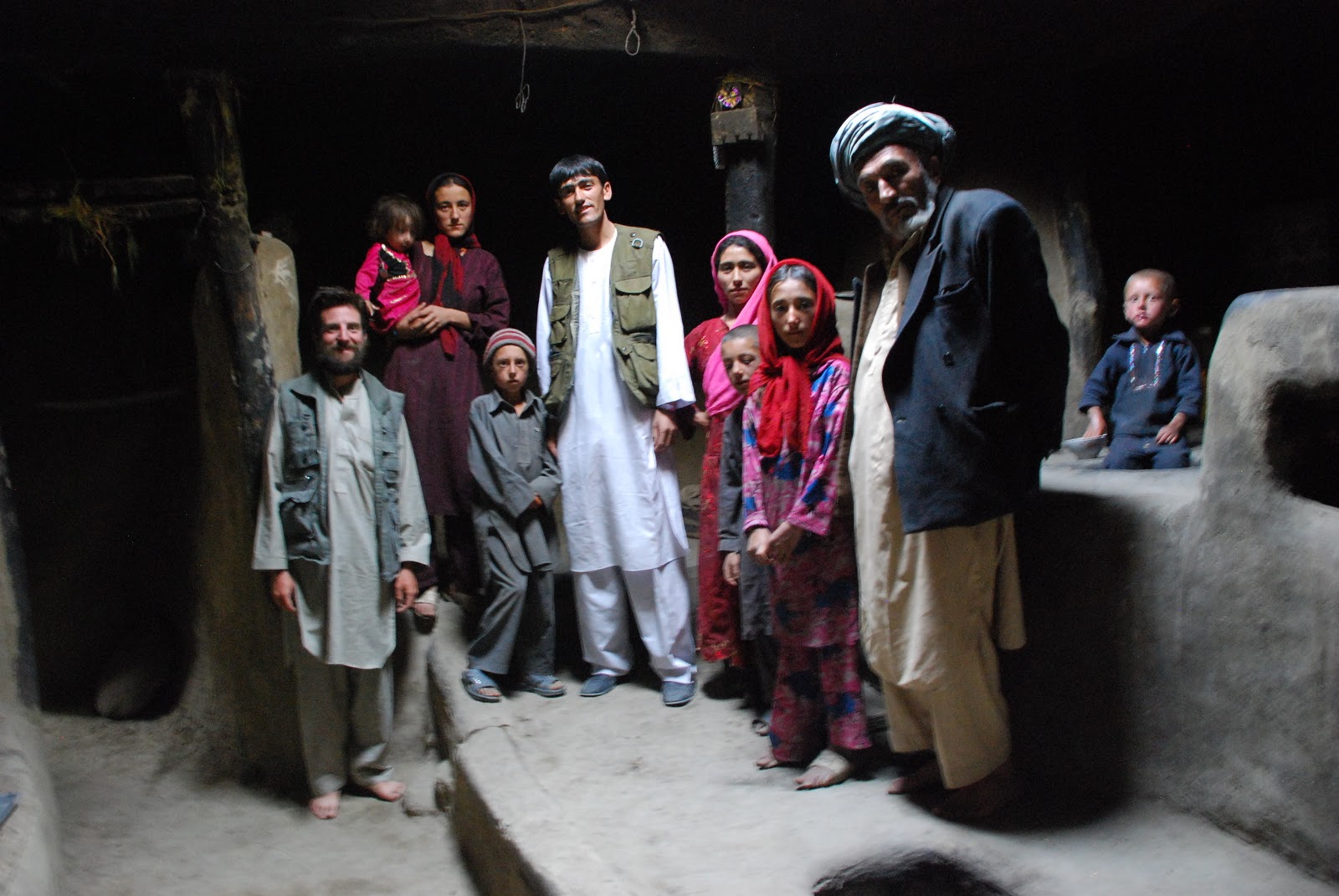
Invited in for tea. Local family in their home

Thursday, 20 October 2011

Across the Oxus

With two weeks of camping food bought in Khorog bazaar we headed south along the Oxus. We drove south, in a taxi, for about 10 minutes until we realised that we had forgotten all our money, having left it by accident at our homestay with the remainder of our belongs which we wouldn't need during the next 3 weeks. The now bad tempered taxi driver sped back and we collected several bundles of 50 dollar notes. We were heading to a place without a bank, post office or electricity beyond what generators could supply - so we really needed that cash.

We had got our visas in London within a week and without too much trouble. There wasn't a queue at the embassy for tourist visas. Afghanistan is not top on most people's holiday destination list.

The drive south follows the Oxus which acts as the border between Tajikistan and Afghanistan in this region. For 3 hours we gazed across the river, which looked wadable in parts, at a place where time had stood still for centuries. There were no vehicles on the other side of the river only men walking with donkeys and women in burqas. Half of Tajikistan's GDP (which is the equivalent of the average Hollywood film budget) is spent on security along its long border with Afghanistan and we passed several Tajik patrols on our drive.

 Afghan/Tajik border post - looking into Afghanistan


The border crossing at Ishkashim is simply made up of the Tajik and Afghan border posts either side of a small bridge. Entering the other side was like stepping out of Central Asia into a different world. A world a lot more Afghan than we were expecting. All of a sudden we were in a world of bearded men wearing shalwar kameez, turbans and women in blue burqas. Now  no one spoke Russian but a surprising amount of people knew some English. Empty shells of Russian armoured personnel carriers lay rusting around town and many people carried small arms. But with a smile and a 'A-salaam Aleykum' we quickly turned the cold stares into warm smiles. The women only seemed to wear their burqas when walking down the one dusty street which was the centre of town. Away from this road the face veil would be pushed up and the burqa balanced to cover only the head.

Typical scene in Ishkashim

We had prearranged being picked up from the border as it was a bit of a walk into town. Two young Afghans came to meet us; Adab who would become very usual indeed and the driver of the car, who was also a guide. He became very excited when we told him that we were English explaining that he had just guided an English man on a trek, his name was Mr John and did we know him? We did happen to meet Mr John later in Ishkashim and managed a brief chat where we did establish that we were in fact from the same home town.


 Dinner at our homestay

 James with a local man and his motorbike

 James meets the locals

 New and old modes of transport in Ishkashim - a donkey tethered to a Russian Armoured Personnel Carrier