Showing posts with label travel. Show all posts

Friday, 8 June 2012

London - overland from Kathmandu, complete.

The Eurostar slid effortlessly into St Pancras Station, London. Suddenly our rucksacks felt weightless as we skipped down the platform. Our families were waiting for us at the exit and a group of friends who mentioned they would come along for the celebrations. There were also a few surprises. Friends who had followed the blog and taken an interest in the trip. Mark who entertained our exploits in Tajikistan and Jo who we met up with in Azerbaijan were there and Adrian and Giulia from Vienna, surprised us by flying in for our return. After a few glasses of champagne to celebrate at the Champagne Bar we headed to a more affordable venue. I asked a group of guys if one of the bar stools was a available. They joked with me about their friend needing a seat as he'd just travelled a long way......... they let me have the bar stool.

So, a final summary of the trip, overland from Kathmandu to London, via a couple of mountains:

# of metres ascended on foot     25800
# of Kilometres travelled            17000
# of days travelled                     265
# of pounds within budget          50
# of countries travelled in           20              (+3 unofficial ones, Tibet, Abkhazia, Nagorno Karabakh)
# of vehicle break downs           12              (all in Kyrgyzstan)
# of flights taken                        1
# of bribes paid                         0


Saturday, 19 May 2012

The penultimate city - Paris

After meeting so many adventurous Belgians on out trip, like Mio in Tajikistan and Uzbekistan and Tommy in Afghanistan, we were tempted to make our penultimate city Brussels on the way home. Despite Mio pointing out that the station the Eurostar left from, London-bound, was also called the Gare du Nord, Brussels just didn't have the same romance as Paris. There was just one problem Vienna had blown the budget so we needed somewhere to stay. Searching our facebook contacts for inspiration James remember that his old French exchange friend from when he was 14 was now living in Paris. Having not seen him for 15 years, but through the wonders of facebook, we sat in a cafe near the Gare du Nord waiting to meet him. All I knew was that he was now a actor.

Looking out the cafe window, across the greyness of Paris in December, I saw a tall, effortlessly stylish man. 'He looks like he could be an actor,' I pointed out to James. 'That's Bertrand!' James replied.

Bertrand was a fantastic host. We stayed on his sofa bed in his bijou Parisian apartment, just a short walk from the Gare du Nord, which was not only conveniently located but a cosy place for weary travellers to put their feet up. Cobbled streets, flower shops and a covered food market with rows of pheasant and geese to tempt the Christmas shoppers were all on the doorstep.

We took in the sights, mainly on foot and where entrance fees were not required. On a cold blustery December day we walked down the Rue Royal over the Place de la Concorde towards the Seine but before crossing the river turned left to take in the Tuileres Gardens and fountains. The glass prism in the Louvre courtyard came into view as we continued, it barred our way, forcing a route across the Seine via the Carrousel bridge and to the South Bank. We got lost in the windy streets of St Germain and Sorbonne and had a pizza slice for lunch before doubling back through the Jardin du Luxembourg and locating a metro station which would take us back to Bertrand's apartment.

One evening we ate in Bertrand's local West African restaurant eating fried fish and bananas, all washed down with an excellent Bordeaux.

The following day, to make the last leg of our journey, we walked to the Gare du Nord in time to catch the 16:13 to London.


Wednesday, 28 March 2012

Stuttgart - home of Porsche

"This is probably the best day out I've had on the trip so far," James exclaimed. We were in Stuttgart  and spending the day with friends at the Porsche Museum, an outing James had been talking about for months. The sleek museum was next to the Porsche HQ and was stuffed full of cars that would  raise even the most reluctant visitor's (me) pulse.


After nearly 9 months travelling overland from Kathmandu back to the UK, gathering visas, overcoming the complex red tape of  the ex-Soviet countries, getting through Tibet in the smallest of windows when the Chinese gatekeepers had allowed it, enduring the roughest roads, climbing the remotest mountains, gaining passage across the Caspian Sea on a cargo ship and travelling through the Southern Caucasus, misadventures and stories aplenty, but after all of that James thought the Porsche museum was the best experience. It would have been a much cheaper trip if we had just spent a weekend going to the Porsche museum instead of all the other travel.

James waiting for the train in Vienna

Our trip to Stuttgart hadn't begun with the Germanic transportation efficiency we had expected from this part of the world. The Vienna to Munich train was delayed, the Austrians blamed the Hungarians the Germans blamed the Austrains. Luckily the rail staff pulled out all the stops to make up time and we got our connection in Munich which delivered us to Stuttgart on time. There, at the station, my friends, Eloise and Philipp were waiting to welcome us off the train. Eloise and I had studied Geography together on a year abroad at McMaster University, Canada, 11 years ago. There Eloise had met Philipp from Stuttgart. Now they are married and have set up home in Philipp's home city. Philipp drove along the windy roads to their flat as if we were in the dying minutes of Le Mans.

Eloise and Philipp were perfect hosts cooking us Schnitzel and showing us around the Christmas market where we drank gluwien and ate tastey German snacks. James and Philipp spent the evening competing on Philipp's full sized seated driving console game which James thought was amazing.


Thursday, 22 March 2012

Ooooooohhhhhhh Vienna

Vienna might not have meant anything to Ultravox but we quite liked it. Not used to having to be anywhere at a particular time we kept Adrian waiting 30 mins when we caught the slow train instead of the fast intercity between Bratislava and Vienna. Adrian was a friend and was working as a diplomat in Vienna. His apartment was exactly how you'd imagine a diplomat's residence to be, a light and airy town house apartment with floor to ceiling windows. Our aim for our stay was to catch up over coffee or wine.

We started by doing this in a local wine bar a short walk away and enjoyed fine wine (significantly better than Uzbek wine) together with a selection of cheese and cold meats. For the next couple of days we ate virtually every meal out, including breakfast. The $20 a day budget was thrown out the window as we visited the best coffee shops, restaurants and bakeries that Vienna had to offer, expertly guided by Adrian. 


It rained for most of our stay but we did do a little sight seeing, in between coffees, and visited several of the art galleries, including the Albertina and the MUMOK Museum of Modern Art, where we found good coffee shops.

On our last night the British Ambassador held a party for us at his residence. OK, Adrian invited us to the work Christmas do. The Ambassador's residence didn't disappoint, a huge house with chandeliers in a classic Vientiane building and contrasting modern art on the walls. Adrian had been adamant that the dress code was casual and jeans would be fine, we hadn't believed him, but when we arrived we were relieved to see that even the Ambassador was in jeans, with a ridiculous Christmas jumper. Carol singing was obligatory and so was the mulled wine.


Saturday, 10 March 2012

A city of two halves - Bratislava, Slovakia

Bratislava is a capital city the size of Chesterfield. It also has a split personality. On the north side of the Danube is the old city, full of quaint cobbled streets and cafes, whilst south of the river is an grey, Soviet tower block-scape. These two parts of the city are connected by a bridge which seems to have had a spaceship crash into it. Some interesting facts about the city are that it is the only capital which borders two countries; Hungary and Austria. It is also the closest neighbouring European capital city (if you don't count the Vatican City and Rome), with Vienna being just 60 km away.


We found a hostel close to the train station, although everything is close in Bratislava. The hostel had the convenience of a substantial bar in the basement. Luckily Bratislava didn't seem to be in full party mode like Budapest so we could have a beer and still manage get some sleep without being disturbed. Bratislava was the location of the gruesome horror film Hostel - I've never seen it but apparently some hostellers come to a bit of a sticky end - and the bar was decked out in this theme.

In the bar was an Italian studying in Sweden. We asked him why he had chosen Stockholm and he readily admitted that his main motivation was for the girls. He was in Bratislava to have hair removal on his chest, presumably to increase his chances with the Swedish ladies.

During the day we wandered around Bratislava a little aimlessly. James was drawn to a toy shop and we whiled away an hour playing with the toys and chatting to the shop assistant. When asked what was the best thing to do in Bratislava he recommended the Clock Museum. We went to check it out but unfortunately it was closed. Instead we walked up to the castle which has commanding views over the Danube. Before returning to the hostel for a beer.


The majority of the next day was spent trying to ascertain whether we could get a boat up the Danube to Vienna. We were meeting a friend in Vienna and wanted to arrive in style as it wasn't just any boat, it was a hydrofoil. Sadly the hydrofoil only operates during the week in the summer, preventing us ticking from off another form of transport on this trip. Instead it was back to the train station.

Wednesday, 29 February 2012

Budapest - Christmas markets, hot baths and, for some, the end of the road

Travelled out and too tried to do our own research any more, we tagged along to a free walking tour our hostel offered. The tour was packed full of interesting facts about Budapest. For example, Budapest has the largest Synagogue in Europe and fifth largest in the world. The Dohany Street Synagogue in District 7, and next to our hostel, seats over 3000 people. During the Second World War the area was known as the Budapest Ghetto where Jews were forced to live. Luckily it was only 3 months after it was set up that the Nazis surrendered Budapest to the Soviet Army and the Jews incarcerated there were released. Closer to home, several structures in Budapest have connections with the London. The Szechenyi Chain Bridge over the River Danube, connecting Buda with Pest, was constructed by William Tierney Clark and Adam Clark. William Clark designed the first ever suspension bridge to span the river Thames (Hammersmith Bridge) amongst others. The second connection with London is the a Parliament buildings. The building is remarkably similar to Westminster's Houses of Parliament (which was in part the inspiration for the design) built in Gothic Revival style and in an imposing position on the river Danube. 


Hungarian Parliament Buildings on the River Danube

For more sightseeing motivation in Budapest we also adopted stalking tact. We'd listen in on people's conversations of what they planned to do and then copied the things we thought would be interesting. We did this with Roman and Joseph, two Slovakians on a gentleman's weekend from Brataslava. They had told us about a Jazz evening and we went to investigate, enjoying a good glass of wine and some great music.

The hostel we were staying in was busy and the dorms full. Guests were there to enjoy the Budapest night life. When we came back from our night of Jazz at 1 am we were the first to return that evening. The rest of our dorm rolled between 6-7 am. The usual pre-Christmas colds were going around and disease was festering among the hostelers. The following morning James came down with something particularly nasty and could only be dragged to the nearest cafe in the morning.  It was a Sunday and there we watch a man order two vodkas and a beer for breakfast.

I left James in the hostel and headed out to investigate the baths Budapest is so famous for. I went to the beautiful Szechenyi baths in the City Park a short metro ride away. The baths comprised of two huge outdoor pools and dozens of indoor ones, all different temperatures, as well as saunas and steam rooms. It was fantastic and I must have spent 4 hours there at least.


Back at the hostel James's man flu had not improved much but the following day, not wanting to miss out, he managed to accompany to the same baths.

We had rushed to Budapest in the hope of catching up with Helen and Jamie (our travel stalkers who had travelled the same route as us from Chengdu, China) one last time. Budapest was the end of the road for them and Jamie's parents had come out to meet them. We met at the entrance to the St Istvan's Cathedral, where the steps led down to a bustling Christmas market. Warmed with mulled wine we chatted to Jamie's mum who had travelled the hippie trail from Australian to the UK through India, Pakistan, Afghanistan and Iran, amongst other places, in the 70s. She talked of meeting fellow travellers along the way, one of which she still keeps in touch with today. It would be nice to think that the same would be true for us with Helen and Jamie.

With Helen and Jamie, esteemed Silk Road travellers, in a Budapest Christmas market

Wednesday, 22 February 2012

Breaking up in Zagreb, Croatia

We were now ticking off the European countries as we headed west. Our plan was to try to visit as many friends as possible along the way. We were travel weary and were beyond spending hours visiting churches and museums. Instead we wanted a chat with someone familiar and a good cup of tea. Impressions of cities were made in milliseconds; tram stop right outside train station, like Zagreb, no map in train station, hate Bratislava.

Our train journey from Belgrade, through northern Croatia to the capital Zagreb was straight forward enough. A local woman, Andrea, sat in our train compartment and we chatted about life in Croatia, being a goth and a mother. In this part of the country there was fighting during the Balkans war and Andrea talked of escaping to the safety of Zagreb during these times.


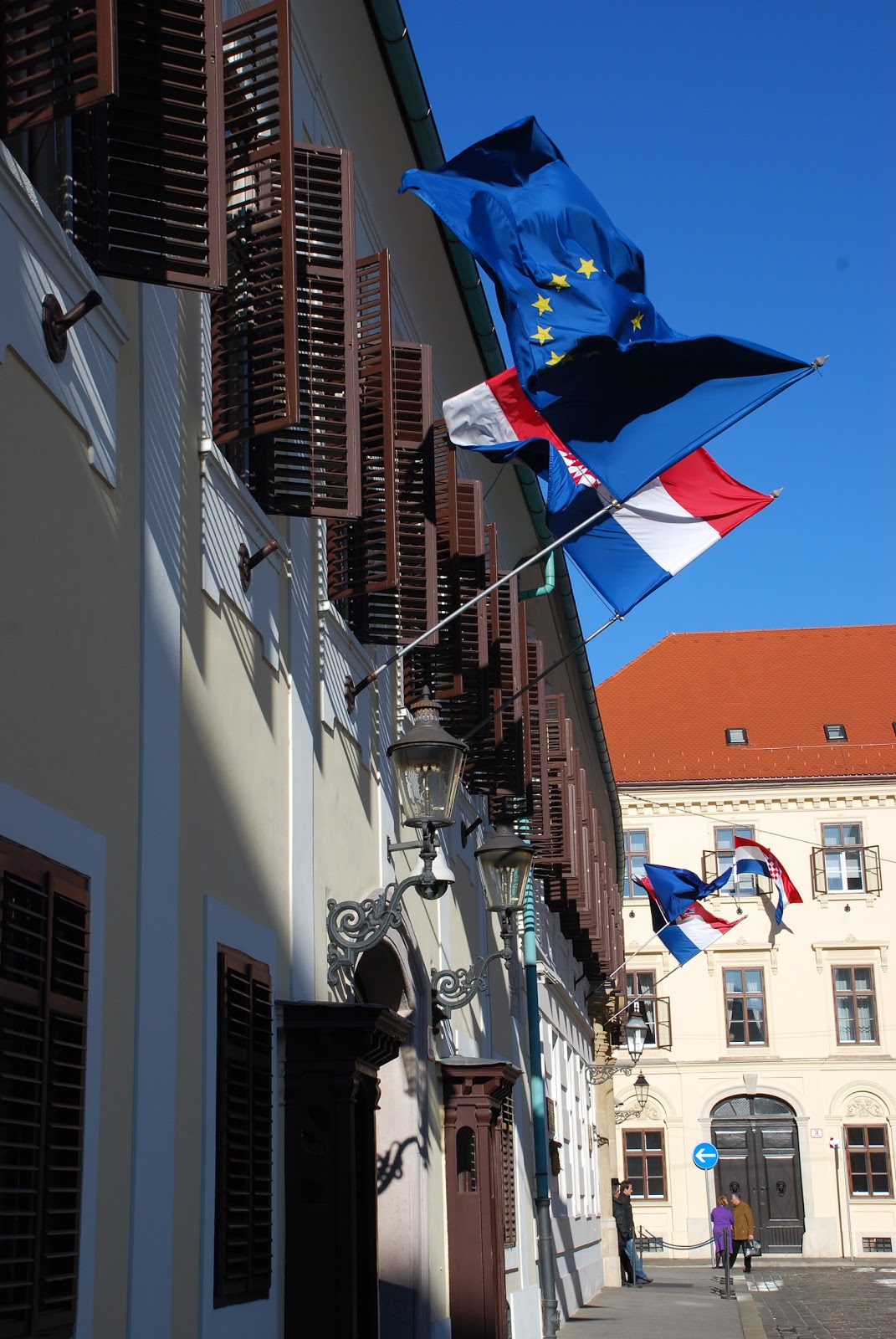
Zagreb was the most European capital so far on our trip and is expected to join the EU in July 2013 and adopt the Euro - that is if still exists of course. It's clean cobbled streets lined with Christmas market stalls; the smell of gulwien wafting through the cold night air as a jazz band played in the park, greeted us off the train from Belgrade. We had come because James had a Croatian friend, Sveta, who he had met 10 years ago whilst he was a student in Moscow and she lived there as her father was a diplomat. That evening we had beers in her flat, a short tram ride away, and caught up.


Exploring the old part of city the following day was easy to do on foot. It was neat and tidy and pretty and I wondered why it wasn't a bigger city-break destination. We stumbled across the quirky Museum of Broken Relationships off a cobbled street and went to take a look. We had the little museum to ourselves as we perused the donated artefacts of ended relationships. Each item represented a relationship and the stories which accompanied them told of funny, sad and happy times in people's lives.

Sveta and James with Sveta's dog

A night out with Sveta and some of her friends in a local bar and then we were on the (rail) road again.

Monday, 13 February 2012

Istanbul to Belgrade - The train west


Bulgaria was our first EU country. We had caught the Istanbul to Belgrade night train, an 20 hour journey, but had come to a shuddering halt the next morning somewhere between Plodiv and Sophia. Strikes. The train guard couldn't tell us when the train would get moving again but it sounded like it might be a while. He suggested getting the bus to Sophia. But it was Sunday and no buses were running. 

There were only a few people on the train. James and I had a six bed compartment to ourselves, next door were three Italian students and then Helen and Jamie, who we first met in Armenia and then bumped into in Istanbul, but even more incredibly had travelled the same route as us from Chengdu in China, and had also got the same train and were next door but one. Helen and Jamie decided to take a taxi to Sophia and James and I headed to check out what the town had to offer.

Our carriage awaits!

After a few enquires and an explore we discovered that the town had two coffee shops (only coffee and beer sold), a supermarket, station waiting room (no toilet) and an cash machine. On the up side the supermarket was playing Christmas songs which we found quite exciting. We went for a coffee and then bought food and beers in the supermarket. Back on the train we ate baguettes and then sat with the Italians drinking beer all day.

That evening the train shunted and groaned before getting going. Within the hour it stopped again this time in Sophia. Looking out the window we saw two familiar characters walking along the platform - Jamie and Helen. They joined us for a beer. 

Although a 12 hour delay might have irritated most people we were quite happy with the situation. The train was due to arrive in Belgrade at 8 pm but with the delay we would now be arriving at 8 am. This meant a second night on the train, a second FREE night. We had a compartment to ourselves and, with the help of another beer, slept soundly through until the morning.

Thursday, 9 February 2012

Istanbul - We love you!

Istanbul, the end of the Silk Road - we'd made it. Elegant minarets pierced the frosty morning air, seagulls circled overhead, neon lights, the call to prayer, wafts of coffee mingled with shisha smoke, this is Istanbul in December. I woke up early in the morning to watch the sun rise over the Bosphorus from the hostel's rooftop lounge, before the rest of the guests emerged, bleary eyed, for breakfast. Later grabbing a fish sandwich for lunch down by the Galata Bridge and a freshly squeezed pomegranate juice on the way home. Then ending the day laying in bed listening the moan of fog horns drifting through the window as ships silently slid past.


Istanbul is vast. It is the 5th largest city in the world (when defined as the population living in city boundaries), which, when you consider all the Chinese cities is pretty incredible. There is so much to see and do it is a little overwhelming. Over five days we combined seeing the classic sights (Blue Mosque, Aya Sofya, Grand Bazaar, boat trip up the Bosphorus and Christmas shopping in the Spice Market) with visiting art galleries. There are many small galleries (some of which are in Banks) on the main shopping drag towards Taksim as well as the Istanbul Modern which has stunning views back towards the minaret laden mskyline of the Golden Horn. One day we combined a visit to a hamam with a look around the Asian side of the city. The most noticeable difference was that the call to prayer was a lot louder. After a good scrub down we did some more Christmas shopping; Turkish Delight for my Dad. I'd told him that there wasn't any Turkish Delight in Turkey so that it might be a surprise. I also wondered if he would manage to guess the flavours, especially the carrot one.


The Aya Sofya was originally a cathedral before it was converted into a mosque in 1453, before it became a museum. Whilst exploring one of the mausoleums we bumped into Helen, who we had last seen in Armenia. We arranged to meet for a beer to catch up that evening. Back at the hostel the staff turned the TV up. The footage showed a gunman armed to the teeth. More pictures of Syria, I thought. Then images of the Topkapi Palace flashed up.

At 9.50 am a Libyan gunman walked past crowds of tourists to the Topkapi Palace gate, ignoring the comments tourists made, and shot two of the guards. He made no demands from the police but wouldn't lay down his arms, so they shot him; dead. We had walked that very route just 10 mins before the incident and, bizarrely, James had commented on the slack weapon handling skills of one of the guards. We had had a pleasant enough day and had been none the wiser to the shootings until our return. The following morning, when we walked past the gates, there was no evidence of the incident at all - they are quick to get the (tourist) business back to normal here in Istanbul.


Now that we were in Istanbul and on a more standard backpacker trail, James and I had been looking forward to regaling stories of daring traveller do to fresh faced gap yearers. But every time we mentioned where we had been a blank look came over their faces and the conversation dried up. I'd try to restart it by bringing up Afghanistan; they moved tables. For the first time we came across a new breed of traveller - the professional travel blogger. Before I had just thought that travel blogging was something you used to let your Mum to know where you were and what you were up to, apparently not. However, to be a professional travel blogger it seems that you have to be female, North American and a ruthless self promoter. 

Aya Sofya

What had struck me most about being in Turkey, and this was reinforced in Istanbul, is what a nice bunch the Turks were. I was expecting the hard sell everywhere and for the men to be quite sleazy. Actually the Turks were very helpful and courteous which they combined with a fantastic sense of humour. I hadn't noticed any unwanted advances until I compared the amount of invitations I had received through my couchsurfing account with that of a fellow couchsurfer, Australian Rob. I had had 11 invitations (all from men) and he had had 1, so maybe the stereotype is justified in the digital world at least.

In short, I absolutely loved Istanbul and didn't wait to leave. It might have been the end of the Silk Road but it wasn't the end of the road for us - we still had to get back to London, overland.


Monday, 6 February 2012

Cappadocia - 'When I grow up I want to be a tourist'

The coach took us overnight through eastern Turkey to Kayseri where we had to get a connection to Goreme. We arrived in the small hours of the morning and the bus station was deserted and freezing. I got into my sleeping bag and found a comfy bench to sleep on until we could catch an onward bus. Just after I dropped off I felt a tug at my feet, 'want tour?' the man said. I didn't even have to say anything to send him scurrying away, my glare was enough.

We found that Goreme was a backpackers mecca, dozens of hostels, souvenir shops and cafes were jumbled around the little streets, backing into the rock pinnacles. Not since Kathmandu had we been somewhere which catered for backpackers so well - we wouldn't have a problem find a banana pancake here. With a bewildering amount of choice we set out to find a hostel. It was bitterly cold so my only requirement was that it was cosy and warm. We found a great place, maybe not the prettiest, but with a lovely sitting room warmed by a wood burning stove in its centre. With the temperatures outside dropping to below -10°the hostel was far from full but there were enough people about for it not to feel entirely deserted.

We spent the next couple of days walking and exploring the surrounding area, as well as eating a lot. During the day the skies were crystal clear and it was warm enough in the sun to sit outside and take a break. Dwellings have been carved out of the soft rock for centuries, the remnants of which are still well preserved amongst the honey coloured spires. Away from Goreme we met few people. A dog followed us, we called him Dennis. We got quite lost at one point and, as it was late in the day, we decided to retrace our steps. Walking up to the road we hitched back to Goreme. Scrambling about the caves had been fun but the stones could be like walking on ball-bearings, so I was not surprised when Nick, a fellow backpacker staying at our hostel, said that he had fallen and hurt his elbow. I offered him Iburprofen which he appreciated.

In the morning Nick's elbow was no better. After a visit to the doctor a dislocation was diagnosed. He had a second appointment to have it put back. Beforehand he nervously waited by the wood burner. 'It'll be fine', I said, 'they'll do it very quickly'. Once he had left James said, 'it won't be fine, it'll hurt like hell.' Of course I knew that but I couldn't tell him.

We decided to spend a day visiting one of the many underground cities which the region is also known for. Derinkuyu is the largest in the area and could accommodate over 35,000 people throughout it's 11 floors if needed. The steps seemed to lead down into the centre of the world as we descended over 85 m to the lowest floor - do not do this if you suffer from claustrophobia. The city's design included a ventilation system as well as a church, market and meeting hall made of caverns crudely cut out of the rock. I thought the most interesting feature was the defence system. There were huge round stones, like upended millstones, which were positioned ready to block off entrances, Indiana Jones style. The city was a refuge for the inhabitants in times of conflict.

Back at the hostel Nick had his elbow in a bandage. After the doctor had manipulated it back into position he had applied honey to the sore joint. Having it put back had hurt like hell, Nick confirmed. We chatted to the owner of the hostel, a South African with a young daughter. She told us that when her daughter is asked what she wants to be when she grows up she always replies, 'when I grow up I want to be a tourist.'

That evening we sampled the clay pot kebabs, a local dish advertised in most of the restaurants. As a meal it is similar to a casserole, but cooked in a clay pot which acts as a pressure cooker. The top of the pot is then cracked open, luckily expertly done by our waiter, and with a gush of steam the contents hiss and bubble out. It was the perfect warming meal to have on a freezing night. 

The following morning, on the second attempt, James managed to coax me out of bed. We had got up at dawn to watch the hot air balloons - a popular tourist trip here. The sky was filled with 30 colourful balloons which drifted silently across the Cappadocia skyline - well worth the early start.

Sightseeing around the Goreme cave dwellings, Cappadocia 

Morning balloon rides

Thursday, 26 January 2012

The Sarpi border crossing - Goodbye Georgia, Hello Turkey

It was time to head west again and cross the border into our first non-ex-Soviet country since China 7 months ago. Marshrutka hopping, we were heading to the the Sarpi border crossing. The most striking thing about this particular border is the Georgian immigration building. A feat of engineering and striking modern design, it is as if the Georgians screaming 'Hello Europe, let us in!!' Although usually a big no-no at borders I just had to get my camera out and take a picture. No one seemed to mind, I am guessing they get it all the time, they can't build a building like that and not expect people to take photographs.

On getting to Turkish immigration they checked our passports and explained that we needed to buy the tourist visa before we could get stamped in. The official waved vaguely to a line of buildings. This was border crossing number 18 on this trip and by far the busiest border we had crossed so far. Trucks and cars waited patiently to cross and there were lots of people milling about. We were confronted with an array of buildings and went into random doors to ask about the visa. Eventually, at the very end of the line of buildings, we found a small booth where we handed over $20 each to get the visa. Why this booth wasn't at the immigration check at the point of entry I don't know.

Our next challenge was to get the visa stamped. We returned to several of the offices we had visited in our initial search but to no avail until I finally put my foot down and demanded that the poor unfortunate official behind one particular desk stamped our passports. He laughed, refusing to be drawn into any argument, happily giving us the stamps we needed and wished us a good trip.

We were on our way again, now all we needed was some form of transport into the local town where we could get a bus. And then it hit us, for 7 months we had been in the sphere of Russian influence and could communicate by speaking Russian, now, with just a few steps, we had left this sphere and with a jolt found that we couldn't communicate what we wanted. We were also sans guidebook so weren't even very sure where we had to go. We knew the next town was called Hopa but every time we asked the minibus drivers they pointed to the taxi rank. We were totally confused and couldn't work out how all the people coming across the border were continuing their journey. In the end an empty minibus agreed to take us to Hopa. When we got to a village called Kemalpasa he dropped us off and, for no extra cost, pointed us to a minibus to Hopa. The riddle was solved. Minibuses from the border only go to Kemalpasa, there you need to change to go to Hopa and beyond.

I am embarrassed to admit that we were quite excited at getting to the coach station in Hopa. The last time we had been on a big coach was the National Express we had taken to Heathrow. It was a sign that we were getting closer to home; closer to things more familiar. At the coach station there was an array of choice. We opted for the next bus to Trabzon and loaded our bags. Then, whilst nosy-ing around the station waiting for our coach to depart we spotted another coach that happened to be leaving for Cappadocia, the place we needed to get to, in 15 mins, no need for any changes! We quickly abandon the first coach and swapped onto the direct one. Welcome to coach travel in Turkey, they go everywhere, any time of day or night, amazing. Within 15 mins we pulled out of the station and settled down to our 16 hour over night journey.

Georgian immigration building, Sarpi border crossing

Tuesday, 24 January 2012

Last trip in the Southern Caucasus - the Black Sea coast

We had now spent several months in the Southern Caucasus of Azerbaijan, Georgia and Armenia. The closed border between Azerbaijan and Armenian, as well as the central location of Tbilisi, meant the we had continually returned to the Georgian capital before setting out again. So, it was with some sadness that we set out on a snowy evening to catch the night train west.

The train took us to the Georgian Black Sea coastal town of Batumi, the capital of the autonomous province of Adjara. It is the third autonomous province of Georgia, South Ossentia and Abkhazia being the other two, but is distinct in two ways. Firstly, it is Islamic and borders Turkey, secondly, it a very stable region on Georgia and has not had any separist movements. As a consequence of this stability it has developed into a resort town and has had some tasteful restoration of the old centre. 

My knowledge of Adjara was however food related. Out of the seven different types of Khachapuri (cheesey bread) I had been sampling over the last couple of months my favourite was the Adjarian Khachapuri which, as I find is often the case, happened to be the most unhealthy, fattening and heart-attacking inducing of them all. I couldn't wait to tuck into an Adjarian Khachapuri in Adjara.

But first we had to find somewhere to stay. The address the taxi dropped us off at, in the grey dawn, was boarded up, so we shouldered out rucksacks and went to hunt for somewhere else to stay. At the next place the owner, flicking cigarette ash onto the thread bare carpet, informed us that we couldn't see the room as someone was still in it. We decided that we had seen enough away and headed up the road to look for somewhere else. After another taxi ride we found ourselves on a street which looked like a building site with a road which comprised of muddy puddles, potholes and rubble. There was no sign at the address indicating that it was a hostel and an Alsatian patrolled the gates. 

It turned out that the Alsatian was a complete softie and the its family owned a large house with several spare rooms which they offered to travellers. With somewhere to sleep secured we headed into the centre of town to find both Adjara Khachipuri as well as Aaron, a friend working in Gori, Georgia, who was taking a short holiday in Batumi with his sister Emy. We were successful on both fronts and over a beer shared a huge Adjara khachipuri. The correct technique for eating such a cheesy delight is to take the boat shaped bread which contains the cheese and melting butter, as well as an egg and mix it all up together. Then proceed to tear off bits of the soft white bread and dunk them in the mix.

The centre of town was a lot less like a building site than the outskirts we were staying in and had retained its charm with cobbled streets and pretty buildings. The sea front had flanked by a broad, wooden walk way and palms. It being late Novemeber, the sea lay still and cold beyond and the beach was wonderfully deserted. 


Adjarian khachapuri - yum

Modern Batumi

Thursday, 19 January 2012

Crossing borders diplomatic style and more dental work

Steve, the British Defence Attache, offered us a lift from Yerevan back to Tbilisi. Needless to say we nearly bit his arm off and were perfectly happy to fit in with his work plans. His chauffeur picked us up, with our grubby backpacks, in his plush Range Rover, outside the British Embassy. It was sleeting as we left Yerevan and the low cloud was reducing visibility on the high passes. I was glad to be in a vehicle which would have passed an MOT, and sat back and relaxed in the leather seat. This was beyond doubt the most luxurious mode of transport we had experienced on our trip. But the best was yet to come.

At the Armenia/Georgia border we experienced border crossings diplomatic style. This consisted of driving to the front of the queue (a Range Rover has no problems mounting the curb and using the pavement), hand passports to the driver, wait for driver to get them stamped and then proceed whilst trying to avoid eye contact with those in the queue scowling at you - knowing full well that the next time I crossed the border I would the one scowling in the queue.

Back in Tbilisi I had to face yet another dental appointment. My dental 'episodes', as James liked to call them, had been numerous, and too long to transgress here. This particular episode had actually started in Nepal on Day 10 of our trek when I cracked a molar but then had been made worse by the Tajikistan episode and now I couldn't ignore it any longer. I knew I had found a good dentist to do the work in Georgia when I noticed that the American Ambassador had the appointment after mine - an American wouldn't just go to any dentist surely?

I needed another root canal and unfortunately this meant lots of injections. The dentist found it very difficult to inject the correct spot to numb the pain and I must have had over 20 injections. The reason for this difficulty was apparently due to me having elderly teeth! Something related to the location of the injection needing to be different for elderly people. I was not quite sure what was more annoying, the resultant bruise on my left jaw or being told that I had elderly teeth.

During the week of dental appointments I developed a sty on my left eye. This resulted in the eyelid swelling up all red. I now had a bruise on my left jaw and a swollen left eye. I looked in a terrible state, and James was embarrassed to be seen with me, thinking that people may have thought that he caused it. Luckily Steve had invited us to stay at his house so I could recover whilst watching the BBC. However, it did mean an emotional goodbye to the Why Not? Hostel cats who I had got a soft spot for.

In between dental appointments James and I managed to fit in a day trip out to Mtskheta (Georgians like strings consonants together). Just north of Tbilisi and a short marshrutka ride away, Mtskheta is one of the oldest town in Georgia and for this it became a UNESCO World Heritage Site in 1994. At its centre is the Svetitskhoveli Cathedral, where I donned a headscarf to take a look around. Mtskheta is also famous its   lobio a hearty bean dish cooked in a clay pot. It was another bitterly cold day, although the sun was shining, and we were glad of the piping hot, filling meal before heading back to Tbilisi.

These were our last few days in Georgia and we were soon to head off on our last journey, west, towards Turkey.

Murky weather on the drive from Armenia to Georgia

Tbilisi in the sun

Mother Georgia - the statue overlooking Tbilisi

Inside the Svetitskhoveli Cathedral, Mtskheta

Woman waits outside the Svetitskhoveli Cathedral, Mtskheta

Wednesday, 7 December 2011

Pick your own pomegranates - Şəki, Azerbaijan

Needing to continue west to Georgia, we had time for one sight seeing trip in Azerbaijan, so we headed to Azerbaijan's top tourist town of Şəki. Jo offered to drive the 'work car', so we loaded our bags into a Red Cross Land Cruiser and hit the road. Driving along the back roads James suddenly shouted 'POMEGRANATES'. Jo pulled over and James jumped out and disappeared into the bushes. For the last couple of years James has become obsessed with pomegranates; there are worse vices but it did nearly jeopardise the trip. Feeding the habit in the UK virtually bankrupt us. Here in Azerbaijan, however, pomegranates are plentiful and the spiny bushes grow everywhere. This was the first pomegranate forest that James had seen and we lost him for a good half an hour as he picked the fruit.

Out of Baku, Azerbaijan is a completely different country. The roads are bad and villages ramshackled. There are very few women seen in public; this was noticeable even after spending so many months in Central Asia. Jo and I were often the only women in the Chaicanas, but the men who served us were very polite and helpful, and I found Azerbaijan to be a warm and friendly place.

The main attraction in Şəki is the Khan's Palace, an attractive, modest sized wooden building. Its unique beauty is only revealed once inside. The light streams through the most intricate and colourful stained-glassed windows, casting multi-coloured reflections around the room. We stayed in the caravanseri just down the road from the palace. A traditional caravanseri building and, although the rooms were not luxuriously furnished, the setting, a construction of sweeping arches around a lushly vegetated courtyard garden, was stunning.

We went out for dinner that evening to an obscure restaurant where we were seated inside a bizarre Swiss-style wendy house, which itself was inside the restaurant. That night in the caravanseri our sleep was disturbed when the room above us had major plumbing issues. Water poured through the ceiling of our bathroom. I was too tired to get up and do anything about it, and it eventually stopped.

The following day Jo drove us up the road, via a pretty Albanian church, so we could catch a bus to Georgia. We established at the bus station that there was a direct bus to Tbilisi but, after we had waved Jo off, the cashier decided that there wasn't one. We ended up getting a series of dilapidated buses to the closest town to the border from where we got a taxi. Driving up to the the border, the taxi slowly filling with fumes as it struggled on the gentle incline, the countryside rolling passed looked remarkably familiar. I told the taxi driver that it looked like England. This, he thought, was the funniest thing he had ever heard. He dropped us outside the border post still chuckling to himself and shaking his head.

Beautiful stain glassed windows at the Khan's Palace, Şəki

The exterior of the Khan's Palace

Our our room for the night at the caravanseri

Tuesday, 6 December 2011

Nowhere in particular in Azerbaijan

Settling into our allocated beds on the scruffy sleeper train from Baku to Barda, I was given the baby. It immediately started crying, so I passed it on to James, where it seemed much happier. We were attracting a lot of attention on the train. Our carriage attendant, a young petite woman with 80s curls, an untucked shirt, her top button undone and tie loosened, was firmly in charge and concerned that we had a comfortable journey. We eventually managed to give the baby back to its owners and went to bed.

After saying our goodbyes we got off the train into the crisp, dark morning and headed to the station waiting room. We had come to Barda (say with a Liverpudlian accent for the correct pronunciation) to see a friend, Jo, who James had studied with in Moscow many moons ago. Jo had been working for the International Red Cross in Barda for the last 2 years. This town is located close to the disputed border with Armenia and has a large population of Internally Displaced People (IDP). The unresolved situation with Armenia means Barda is a sensitive area, combined with the fact that there is really nothing for tourists to see, any outsiders raise suspicions. Whilst we waited for Jo to pick us up a constant stream of taxi drivers popped their heads around the door to enquire if we needed a ride. Then three men in suits entered the deserted room and, instead of sitting in the empty row of seats across the room, they chose to occupy the sits either side and opposite James. After a long silence they struck up some small talk. After appearing to get the information they were looking for they got up and left abruptly.

At Jo's house we had all the home comforts we had been craving and had been denied since our stay with Phil and Alison in Tashkent. We completely indulged, having a great shower and devouring Jo's DVD collection. The sights of Barda were left for another visit.

At the scrapyard we met someone familiar.

Jo and James pose next to Jo's work car.

Saturday, 3 December 2011

Old meets new in Baku

I didn't know much about the capital of Azerbaijan before visiting. I didn't have high expectations, imagining an ostentatious city built on oil wealth (BP has its biggest operations here). And yes there are some flashy buildings but there is also an old town which is an UNESCO world heritage site and a pleasant pedestrianised centre. After the empty streets of Uzbekistan and Turkmenistan it was wonderful to see some life. People were sitting outside cafes enjoying a coffee, the shops were teeming and couples walked along the sea front. It felt very western compared to Central Asia, with many familiar brands. I hadn't realised how worn down I'd become over the past month. The food had become monotonous, constantly negotiating shared taxi fares tedious, visa paperwork onerous and some of the police tactics just plain ridiculous. Now, that was all behind us and there were no obstacles in our way to prevent us completing over overland trip I felt re-energised.

There were pastry shops everywhere and the Azerbaijanis had waistlines which attested to the fact that they were often tempted. We happily indulged too. Despite having a pleasant day wandering around the compact city centre and old town we were not going to pay the inflated hotel room prices to stay another day. With a ticket on the night train costing just a couple of dollars, it was the cheapest bed in town, so that night we were trundling westward again.

Friendly locals on the seafront

Sunday, 27 November 2011

Samarkand, Bukhara and Khiva - mosques, madrassas and minarets


For lust of knowing what should not be known
We take the Golden Road to Samarkand

Eloy Flecker, 1913


The three ancient cities of Samarkand, Bukhara and Khiva with their tiled blue domes and Great Game history were the initial inspiration for travelling to Central Asia. So it was with great excitement that we got the train to Samarkand. Rounding the corner in a taxi we finally saw the Registan, a huge blue domed monument of Islamıc architecture. We stayed in a homely backpackers hangout close by, with a vine the size of a tree in the courtyard and pots of tea and water melon brought out every time we sat down. It was there that we bumped into Mio, who we had first met in Khorog, Tajikistan, over a month previously.

We were now fırmly in the domain of group tours and large groups of grey haıred tourists, who were clearly spending the kids inheritance, and who were being ushered from one sight to the next around us. We took a more lesurily pace walking around the Registan, the Shahr-i-Zander Monuments, a narrow avenue of gleaming blue tiled mausoleums, the Bibi Khanym Mosque, the Islamic world's biggest mosque when it was built at the end of the 12th Century and the Mausoleum of Timur. Soviet archaeologists opened up the mausoleum in June 1941, despite dire warnings for anyone who did so. The following day Hitler attacked the Soviet Union.

One evening we were taking a walk down past the Registan and heard music blaring out of a restaurant. We thought we would go and have a look at what was going on - big mistake. It looked like a wedding and some drunk Uzbek men rolled out of the door and grabbed us, insisting that we joined the party. We were shown to a table where several other wide eyed tourists were being held hostage. It turns out that the party was a celebration of a circumcision. There must have been around 200 people at the event but now only the drunkest remained. We eventually managed to make our excuses and leave.

Next stop was Bukhara. We caught the train, appreciatıng every minute of a more familiar form of transport rather than the rigmarole of shared taxis. In Bukhara we bumped into Australians Ned and Morgan as well as Iranians Rita and Mo, who we had last seen in Dushanbe, Tajıkistan. This meant lots of drinks and a good catch up.

We did also manage to fıt some sightseeıng in, the huge Klyan minaret and surroundıng madrassa and mosque as well as the fortress known as the Ark. Bukhara is at the centre of many a Great Game escapade and James and I made a special visit to the jail into which the fated British Army Officers, Stoddart and Connolly, were incarcerated in the 'bug pit', which to our delight was still there. My favourite sight was the little visited Modari Khan madrassa. Clearly not on the tour group circuit, we had the run of this deserted building, climbing up the crumbling stairs onto the roof from where we could see across the city. Our hostel was opposite one of two sinogoges in the cıty and we had a look around, intrigued at the Jewish community in this ancient Islamic city. Although beautiful in every sense the old city lack something. After the bustling markets and cities of the rest of Central Asia it was disappointing that the only people in the old city were tourists and souvenir sellers. The old town felt like a sanitised museum.

On our last evening we went wine tasting in a tastefully decorated whitewashed cellar. That was where the tastefulness ended as Uzbek wine is not about to fınd its way into any Michelin stared restaurants. It is incredibly sweet and resembling something closer to sherry. However, with the Australians, a couple of other Brits, two Americans and our very kind Uzbek hosts we had a hoot and the drinking continued back at our hostel.

The following evening we caught the night train to Khiva. James had eventually managed to buy tickets after much confusion and had helped another tourist get hers too. Teressa was a air hostess from Spain and one of the most fascinating people I've met. She had had the most incredible life, including studyıng for a PhD at Oxford. After changing trains in the middle of the night we ended up on a stifflingly hot carriage chugging through the Kyzylkum desert. Bizarrely it was occupied entirely by women, children and James - as if a town somewhere had been evacuated. It was too hot to sleep and was told off when I attempted to open the window. It seems that  windows are for throwing rubbish out of - not for ventilation.

In Khiva we wondered around the sights but we were now at saturation point when it came to mosques, madrassas and minarets. Khiva was even quieter than Bukhara when it came to local life. We did climb the minaret by the East Gate for giddy views over the city and walked along the city walks one evening.

We left Khiva to take a tour around the many unrestored forts in the area, planning on stayıng ın a cheap hotel on the way to our next destination. However, were forced to return when we couldn't fınd an affordable hotel that would take foreigners. The next day we had to retrace our steps to get to Nukus.

The Registan, Samarkand

Mosque in Bukhara

James hangs out with some Uzbek tourists in Bukhara

The unfinished minaret at Khiva

Saturday, 19 November 2011

Khujand - Last stop in Tajikistan

Yet another epic journey between main Tajik towns, via terrible roads and over mountain passes. The journey was only bearable with the knowledge that this was our last shared jeep journey on this trip. James and I were squeezed into the two seats at the back of the jeep with a third person. Various other bits of luggage were wedged in around us and a budgie in a cage was passed in for us to hold. We bounced along in the back of the jeep through the Fann Mountains. At one point the road dived into the side of a mountain. The tunnel was unlit and thick with fumes. It was several inches deep in water which concealed crater sized potholes. The air was so bad and the tunnel so long that I began to develop a headache. We began to wonder whether we were transporting a budgie for a reason. Luckily we all made it out the other side alive - including the budgie.

In Khujand we checked in to a rather politically incorrect hotel called the Leninabad Hotel. It was a crumbling Soviet building with bathrooms which were sure to be a breeding ground for Legionnaires' Disease. A more appropriate name would have been the Lenina 'Very' bad Hotel. Morten, the Danish motor biker we had met outside the Turkmen embassy in Dushanbe was also staying here.

After settling in we met with Azamov a NGO worker who James had met in Kyrgyzstan. He gave us a whistle stop tour of Khujand. Many new buildings had been opened to mark the 20th year of independence celebrations including a swimming pool. Azamov managed to get the museum opened for us. It was great to have the place to ourselves as, although small, the artefacts were much more imaginatively exhibited than the other Central Asia museums we had been to. Azamov won't let us pay for anything including the museum and an ice cream in the park, we were his guests he kept insisting.

Khujand was yet another Tajik town which resembled no other in Tajikistan. It is affluent with several universities and is located in the fertile Fergana valley. Azamov, a highly educated professional, had only been to the Tajik capital once, by train through Uzbekistan when the Uzbeks had allowed this. Now it was difficult for Tajiks to travel through Uzbekistan and the only way from the north of Tajikistan to the capital was via the potholed road we had taken.

After our whistle tour of Khujand, Azamov drove us back to his family home where we met his mother, children, wife, brother and brother's children. His mother spoke excellent English and enjoyed practising, whilst her grandchildren ran about giggling. We ate dinner together and then were introduced to the rest of the family via various DVD's filmed at family events.

Wednesday, 16 November 2011

Princess Diana and Dentists in Dushanbe

James peered into my mouth as the dentist was explaining something to him in Russian, as soon as he saw my tooth he reeled in horror. This is not the reassurance that is needed when you are having to have some major dental work on the other side of the world.

The tooth ache had started a week ago when a filling had fallen out and I had been trying to ignore it. Each day the pain would gradually build until it was too painfully to sleep and I had to resort to strong pain killers. I was going to have to see a dentist. I phoned my insurance company to find out what I would need to claim for the treatment. As I explained the situation to the person at the other end of the phone I could hear an audible gulp when I mentioned I was in Tajikistan. "Are you in...........the capital?" he replied "Yes, in Dushanbe" I said helping him out.

We had arrived in Dushanbe from Khorog which was a gruelling jeep ride through the Pamirs. We'd heard horror stories of it taking 22 hours, so were expecting the worst. For the first four hours or so the road (read dirty track at best) follows the Afghan border, through a gorge and beside the Oxus River. At one point we noticed a crane parked at the side of the road. In the river two back wheels of an upturned car were all that could be seen of the wreckage. The scenery changed suddenly as we crossed the pass to Dushanbe and we cruised into town after only 13 hours on the road. We had shared the jeep with a Tajik family who had done the trip from Murghab in a oner (2 days on the road) and a Belgium backpacker, Mio, who we had met in the homestay in Khorog. One of the Tajik women spent the entire journey discretely vomiting into a plastic bag and then throwing it out of the jeep window. On arrival in Dushanbe we celebrated with Mio in 'beer square', a collection of make shift outdoor bars around a fountain outside the Opera House, busy with locals. We soon discovered the local beer SimSim and, with two Australian backpackers, Ned and Morgan, we became regulars there.

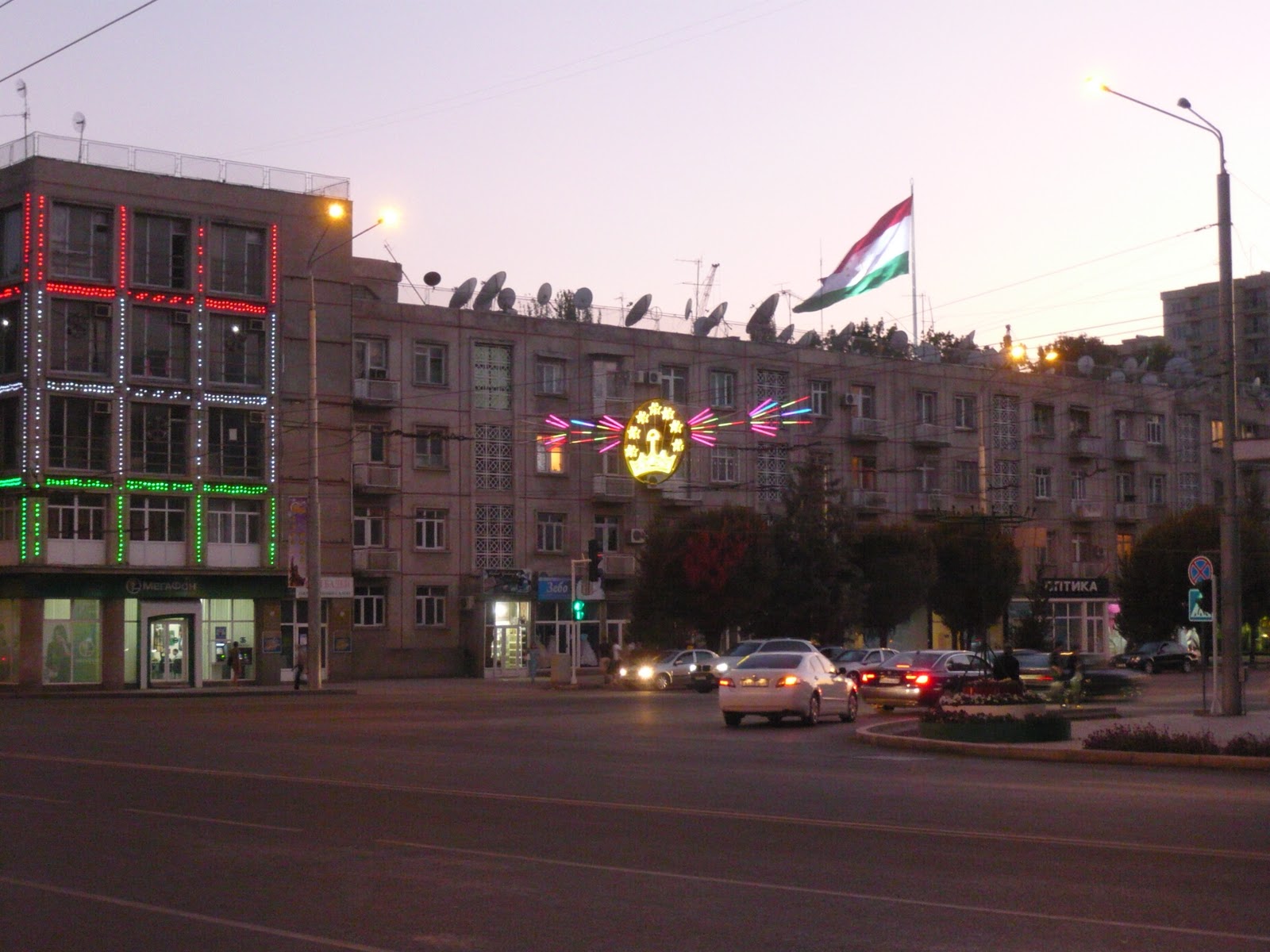
Dushanbe with the huge Tajik flag dominating the skyline

I ended up needing 3 dental appointments over a week for a root canal and filling and was a little worried about the final bill, however it ended up totalling $60, so therefore didn't curtail the SimSim drinking. In between dental work James and I spent our time filling out forms in various embassies for the next round of visa applications.

Unfortunately accommodation wasn't as cheap as dentistry in Dushanbe but a local couchsurfer came to the rescue. Despite going on holiday the evening we arrived, Ryan, gave us the keys to his flat. It was wonderful to have a homely little place to go back to after several hours in the dentist's chair.

Whilst hanging around in Dushanbe I also thought I would get my haircut. I was very tempted by the Princess Diana Salon but decided that I didn't actually want a Princess Diana cut so headed to a less fancy place. Life in Dushanbe is beyond laid back so it was very easy to slip into a routine of doing not a lot. The impending expiry of our Tajik visas got us moving again.

 Me with local Tajik women in Dushanbe. The women are wearing the typical 'nightdress' and featuring 'strong' eyebrows