Showing posts with label Nepal. Show all posts

Friday, 8 June 2012

London - overland from Kathmandu, complete.

The Eurostar slid effortlessly into St Pancras Station, London. Suddenly our rucksacks felt weightless as we skipped down the platform. Our families were waiting for us at the exit and a group of friends who mentioned they would come along for the celebrations. There were also a few surprises. Friends who had followed the blog and taken an interest in the trip. Mark who entertained our exploits in Tajikistan and Jo who we met up with in Azerbaijan were there and Adrian and Giulia from Vienna, surprised us by flying in for our return. After a few glasses of champagne to celebrate at the Champagne Bar we headed to a more affordable venue. I asked a group of guys if one of the bar stools was a available. They joked with me about their friend needing a seat as he'd just travelled a long way......... they let me have the bar stool.

So, a final summary of the trip, overland from Kathmandu to London, via a couple of mountains:

# of metres ascended on foot     25800
# of Kilometres travelled            17000
# of days travelled                     265
# of pounds within budget          50
# of countries travelled in           20              (+3 unofficial ones, Tibet, Abkhazia, Nagorno Karabakh)
# of vehicle break downs           12              (all in Kyrgyzstan)
# of flights taken                        1
# of bribes paid                         0


Tuesday, 7 June 2011

Arranging a Tibet Tour In Kathmandu - The good, the bad and the ugly

So, with the benefit on hindsight, I can reflect on the experience of organising an overland tour from Nepal through Tibet and into China. Hopefully this post will help those trying to do this trip themselves. Two main problems have to be overcome, firstly, the whims of the Chinese regarding border closures and regulations and secondly, the aggressive sales tactics and misinformation given out by the Kathmandu travel agencies. I will tackle these one at a time.

It is important to understand that the border between Nepal and Tibet is often closed. This is a regular occurrence in March but can happen at any time without warning. It is only possible to travel in Tibet as part of a group tour. Group tours come in several forms. The private tour which involves a group of up to four people travelling in a jeep or a budget tour which is a group of 20-30 (22 people in our group) travelling in a coach. The Chinese border can be closed to a certain type of tour – especially budget tours, whilst not to others, so to be more certain of getting into Tibet take a private tour. We had to wait an extra week in Kathmandu for the border to open to budget travellers; it was open during this time to private tours.

The next thing to understand is that to travel in Tibet from Nepal a group Tibetan permit has to be obtained. This is a piece of paper with the names and passport details of the group. Nothing is stamped in your actual passport. All those people on the group permit must enter Tibet together, travel in Tibet together and then exit Tibet together. It is, however, possible to travel in a group but on different group visas and it is also possible to be a group of one. For example out of the 22 people on our tour the majority of people were flying back to Kathmandu on the same flight and hence were all on the same group permit, but there were also at least 5 different other ways people were travelling on from Tibet; flying to Chengdu, getting the train to Beijing and, for us, getting the train to Chengdu, and therefore we were all on different group permits. If travelling onto China the Tibetan permit allows you to travel in China without the need for a Chinese visa, but you will have to travel with everyone else on the group permit and exit China with them. No matter what the agencies in Kathmandu say it is impossible to extend a Tibetan permit or change it for a Chinese visa in China. You have to make sure you leave China by the time the visa expires. If you want to spend more time in China the easiest thing to do is to go to Hong Kong where it is easy to get a Chinese visa. There is no point getting a Chinese visa before a Tibetan tour as all Chinese visas get cancelled when a Tibetan permit is obtained. The normal length of time for a Tibetan permit is 14 days; this time includes the time on the tour (usually 8 days) and therefore only gives 6 days to travel in China. It is possible to get 21 or even 30 day Tibetan permits in Kathmandu for an additional fee but we were told that it wasn’t possible on this occasion. The fine for overstaying your Tibetan permit is 500 Yuan a day (the same as for overstaying a Chinese visa). So to summarise, make sure your travel agency puts you on a group Tibetan Permit with the people you will be entering and exiting China/Tibet with and if you want to travel in China ask for the longer permit. And don’t listen to what they say about it being easy to extend a permit - it is not possible!!

So, next to the travel agencies in Kathmandu. Nearly all travel agencies are middle men who take your money, get you to fill out a form and hand over your passport and then pass it onto an agency which organises the permits and tour. The initial agency then tend to lose interest in you. The prices for a budget tour did not seem to vary much between agencies but I think the service you get does. A budget tour including B&B and permits costs around $360 there will be an additional cost for onward transport out of Tibet. I can only speak regarding the train tickets but the mark up on these is huge – over double. The agencies will tell you that having one is a requirement for obtaining the Tibetan permit. However, we now know that our tickets were only bought by the Lhasa agency once we got to Lhasa. I’d recommend buying the train ticket yourself online to save some money. For example using http://www.chinatravel.com/. Again, the Kathmandu agencies will tell you that you can’t do this – but other people had. The travel agencies will also try to charge more for an express Tibetan Permit. The cheapest permit is when the paperwork and passport is submitted 10 days in advance. In reality all Tibetan Permits are obtained the day beforehand. Knowing this may mean that you can negotiate the price of the ‘express’ service. 

Despite the struggles beforehand in Kathmandu and then afterwards in China, when we had to make a dash for the border, the tour itself was very enjoyable. We began the tour in a typical Nepalese bus with a Nepali guide provided by Tibet International. At the border we left this bus behind (thankfully) and carried our luggage through Nepalese immigration, over the Friendship Bridge to Chinese immigration and our next bus. In total the distance from bus to bus is about 1 km and it took us about 4 hours to get through all the checks. It is possible to hire a porter for about 250 rupees to carry bags from one bus to the other (they should carry ID to get across the border themselves). There are also plenty of money changers about to change money. The Chinese searched our bags fairly well (although if you are not first in line and bury things deep enough they won’t find them). They took particular interest in all books. The guide warned us not to bring any books about Tibet across the border, especially the Lonely Planet. However, the Chinese also took a disliking to the Nepal Lonely Planet. This was sent back to Kathmandu with the Nepali guide for the owner to pick up on their return. We met our Tibetan guide at the border and transferred onto a much nicer and very comfortable coach-style bus provided by Tibet Tashi Delek.

Once in Tibet we saw all the usual sights – spectacular views and beautiful monasteries. Our guide was very good and the bus driver was only a maniac on a couple of occasions. We had an additional guide in Lhasa who was very enthusiastic and even took us out to a local nightclub one night. The accommodation we stayed in varied from truly awful improving throughout the tour to bordering on luxurious on the last couple of nights (The Trichang Labrang Hotel). Breakfasts were basic but OK. Another point to note is that the tour gains height very quickly, on the second day you are at 5200m! It is therefore important to know how to act at altitude in order not to get sick and to be prepared. Our guide gave us no advice on this but did have oxygen at hand - and this was needed!

It is much easier to travel from China into Tibet and on to Nepal rather than this way around but if you are in Nepal and don’t have the choice this is still an opportunity not to be missed. I hope that these tips have been helpful and please feel free to write any comments of your own experiences below.

This information was correct on 14th May 2011, 9.11am and 47 seconds!!!!

The Budget Bus

Thursday, 2 June 2011

Crossing the Friendship Bridge

The border was finally open to budget travellers and the friendship bridge was the gateway from Nepal into Tibet. Our budget tour was the first to cross the bridge since February. Team Budget, as I called the motley collection of people, thrown together in a desire to see Tibet, was made up of 22 people of which 15 nationalities were represented. This included people from all the populated continents except North America.

We set off from Kathmandu on a rickety bus, bumping uncomfortably along the Nepalese road. By late morning we had arrived at the border where we left the Nepalese bus and walked through Nepali immigration, across the Friendship Bridge and on to the many Chinese checks. James and I soon realised that we'd hired the only drug addict in town to porter one of our three big bags the 800 m from the bus to the Chinese immigration. We closely supervised him as he tried to renegotiate the price. Whilst doing this we were also mobbed by a throng of money changers and everywhere we walked there was a chorus of “Change money?”

At Chinese immigration we had a long wait before searches of our bags commenced. We had been warned by our guide not to bring any books about Tibet (particularly the Lonely Planet). I, however, was more worried about what they would think of the GPS, walkie talkies and homemade maps I had. So, the night before I had done some careful packing. It was a difficult balance of not wanting to look like we'd deliberately concealed the items but make them difficult to find on a routine bag search. The GPS had been packed in the depths of the 4 season sleeping bag which had then been stuffed into a compression sack, then a dry bag and finally in the large holdall. The walkie talkies were placed in the toes of the mountaineering boots with socks stuffed on top of them. And the maps were placed in a document wallet with my emergency supply of tampons – an attempt to embarrass the inevitably male officials so they wouldn't through the wallet.

The first in the group to be searched had to remove everything in his bag and then repack. The Chinese officials scrutinised every book they found. When it came to our turn the officials started looking through the black holdall, inside were concealed the GPS and walkie talkies. We tried to act casually, when suddenly one official found something of great interest. He called over his superior and they crowded around the item. The superior was trying to say something to us, “Turtle”, he said, “Turtle”. We looked confused. “Churtel, Churtel” then “Premier”. He smiled and gave a thumbs up. What they had found was the Winston Churchill commemorative coins James had brought as gifts. More thumbs up and we were waved through. All in all it had taken about 4 hours to cross the border, with one Nepal Lonely Planet being the only casualty.

The Friendship Bridge - Inside Tibet looking across the border to Nepal

Thursday, 19 May 2011

Kathmandu - City of Temples (and Traffic)

The Nepal/Tibet border was closed to foreigners and had been since February. Rumour was that it would open in a week’s time. This meant that we had a week to kill in Kathmandu. Apart from delaying us this wasn’t such a hardship there were still plenty of places we hadn’t yet visited in the city. So we went on a temple binge, visiting all of the temples mentioned in our guidebook. Durbar Square a short walk away and on the way to was the best cake in Nepal at Snowman Café on Freak Street. We went to the Hindu holy sight of Pashupatinath, where open cremations take place. It felt a little it uncomfortable paying to walk around a temple site seeing funerals taking place. The site is next to the holy river of Bagmati River which was all but a trickle and disappointingly non-Hindus were not allowed into the temple itself. We peered through the gate and saw a huge gold statue of a bull or a least its rear end, complete with balls the size of space hoppers. A more worth while trip was to the Durbar Square at Patan. Cleaner and tidier than the Durbar square near Thamel we spent a pleasant afternoon there. We decided not to eat in the interestingly named ‘Third World Restaurant’ next to ‘Third World Guesthouse’ and found a quiet place with a pretty courtyard garden. On another day we marvelled at the urban sprawl of Kathmandu from Swayambhunath Stupa and enjoyed the Buddhist calm at our favourite Stupa of Bodhnath. But these sights were just a handful of temples, stupas and holy sites in Kathmandu. We saw many more on our ambles around town, tucked away down little streets or surrounded by traffic jams. In between this, Gopal, our trekking guide, invited us to dinner at his flat in a suburb of Kathmandu. We had a lovely evening, although dinner was so late that at one point we thought we’d misunderstood and were about to thank him for the tea and head back. Later in the week we learnt how to cook Dal Bhat ourselves when we went on a mornings cooking course.

It wasn't until we left Kathmandu to go on our trek that James said 'oh, so they do actually drive on the left here.' Most of the time in the city it is impossible to tell which side of the road cars are meant to be driving on. And with the traffic comes the pollution which chokes the whole of the Kathmandu valley. When Kathmandu got a bit too much we headed to the Garden of Dreams on the edge of Thamel for a picnic. An afternoon in this oasis of calm where you leave the chaos and smog and traffic at the gate kept us sane, in between visits to Snowman Café. 

Apart from the traffic and consequent pollution, there are piles of rubbish and the stinking clogged rivers, amongst which people try to navigate the streets, tripping over each other, it is desperate poverty which is so difficult to come face to face with. But whether it is street children picking though the rubbish, the leper begging in the street, the horrifically burnt woman asking for a rupee or the man in the wheelchair selling newspapers trying to adjust to plastic bag he is using instead of a catheter. The poverty is overwhelming and although individual situations are desperate the saddest part of the poverty in Nepal is the lack of opportunity. Illiteracy is 70% and families have to sacrifice everything to try to put their children through school, but for what? Many people are trying to seek work aboard, a brain drain which just exasperates the situation. The government, nearly a year after the first constitution amendment deadline, is still squabbling. The next deadline is on the 28th May and despite the government parties promising that they wouldn’t call strikes during Nepal’s ‘year of tourism’ this looks unlikely. Combined with fuel shortages it is creating yet more hardship for the people.

There was a strike on today and the roads were wonderfully quiet and Thamel was actually pleasant to walk around. We waited around nervously as it was the day before we were meant to be leaving on our Tibet tour. The day had not started well with our tour agency changing the goalposts again and more misinformation. We decided the best option was to spend the day in the Garden of Dreams and have a picnic there. Unfortunately, whilst trying to leave the hotel a power cut struck, trapping us in the lift. Trapped in the darkness of the lift, with nothing to do but wait to be rescue, I ate the picnic. We eventually made it to the Garden of Dreams.

We couldn’t afford to stick about whilst the inevitable strikes crippled the country but no one knew if the border would open the next day. If it didn’t then we would have to fly and this would mean our overland dream back to the UK would be over (and we were pretty worried about how much the excess baggage would cost us).


Hindu holy site - Pashupatinath

Golden balls at Pashupatinath Temple

Patan Durbar Square after some rain

Monkey at Swayambhunath Stupa

Our sanctuary the Garden of Dreams

Boudhnath - my favourite stupa

On a Dal Bhat cooking course - adding the spices

Diarrhoea Greek for 'flowing through'

We'd hoped Pokhara would provide a few days relaxation after our trek. Unfortunately it didn't turn out that way. My mistake was to order western food, a chicken burger. By that evening I was becoming well acquainted with the toilet bowl as I vomited my dinner back up. Luckily it only lasted 12 hours or so and by the morning I was feeling much better although weak and tired. James on the other hand had picked up something different. A stomach bug which gave him terrible cramps and resulted in him running for the loo. Apart from being virtually impossible to spell diarrhoea can be quite stubborn to get rid of. James of course ignored all my helpful advice and after three days of testing my sympathy to the limit (I think I was born without a sympathy gene so it doesn't take much) I reached for the 'Wilderness medicine handbook' and armed with the name of a suitable antibiotic, marched down to the nearest pharmacy. A well spent 2.50 pounds later I force fed James the rather large pills and repeated 12 hourly.

It was a shame as Pokhara is quite a nice town. Although it is Nepal's second city, Pokhara could be in a different country when compared to Kathmandu. It is low rise and has wide, open roads and, down by the lake, a great feeling of space. Quiet and sleepy with plenty of restaurants and bars it is the perfect place to relax after an arduous trek. There is just one problem, and it might be because I've missed something, but after visiting the temple in the lake, the peace pagoda, the Gurkha and Mountain museums, it is a little boring. It is probably a controversial choice but I much prefer Kathmandu.

James recovered just before our bus back to Kathmandu, which was just as well as it took 8 hours.

Tuesday, 10 May 2011

'Take Cover!' on the Annapurna Circuit

Day 18 - Upper Pisang (3310 m) to Chame 4hrs Teahouse
The legs were no better in the morning and we hobbled to Pisang village, where for the first time we saw Pisang Peak from the bottom of the valley - we hadn't seen it on the route we had taken on the walk in, which was probably a good thing, as it looked intimidating.

We would now be retracing our steps to where the Annapurna and Manaslu circuits joined, but this time against the flow of Annapurna trekking traffic, which would confuse all the Annapurna trekkers.

James was in an extremely bad mood this morning. We needed to have a blazing row to clear the air but Gopal, not sensing the atmosphere, had decided that we needed especially close supervision this morning. In the end we had to insist he let us walk on our own. Once he was out of ear shot we had a massive row mainly based around James's dislike for climbing and the fact that I force him to do it. I quickly decided to change the subject to James's favourite topic of discussion - food and in particular what he was planning on eating when we got to Pokhara.

It was Easter Monday and getting to Chame gave us an opportunity to send an email home. We stayed in the same teahouse as before and watch in great amusement as a completely crazy guide had a conversation with 3 stoned Israelis.


 Me walking into Chame

Day 18 - Chame to Lower Danaque 4 hrs Teahouse
As we were now trekking against the 'traffic' we got a good idea of the main nationalities trekking the Annapurna Circuit. The overwhelming nationality was Israeli. I speculated that this is due to the fact that trekkers do not need to hire a porter or guide and therefore Israelis can walk the whole circuit without actually talking to anybody else, but just my theory. In second place came Germans and in third Koreans. Then there were French, Slovakian, Ukraine, Poles, Japanese and Danes.

We descended through villages where wild strawberry plants were in flower and then the peace was shattered by a series of huge explosions. The noise rattled around the mountains repeating it back to us again and again. It was the sound of blasting for the dogged road building which was creeping up the valley. Still must make the Israelis feel at home.

Goat jam - not for eating.

Dal Bhat power for 12 hours!


Day 19 - Lower Danaque to Syange 8 hrs Teahouse
Gopal was keen to stay in Lower Danaque again and we didn't mind too much as the we had another fantastic meal with chicken curry, but this left for a long, hot day today. We begun the day in sub-tropical forest and the strawberry plants had given way to swathes of cannabis.

The trail was fairly pleasant to Tal but afterwards it became a steep, narrow, dusty path where we had to constantly dodge oncoming locals, trekkers and mule trains. On the other side of the valley the valley side was under full attack from the road builders. The sound of pneumatic drills and generators for hours on end was not what I had in mind for a trekking holiday. We descended to the valley floor and two soldiers barred our way. We protested but soon realised when they crouched behind a boulder that it was probably for our own safety. We copied and after about half an hour several explosions ripped up the valley followed by plumes of dust.

Back down to the tropics

Day 20 - Syange to Bhulbule 5 hrs Hotel in Besi Sahar
Today was actually quite a pleasant walk. The road, in the loosest sense of the word, had been completed here so there was not road building noises. As the road was actually little more than a track there was virtually no traffic on it and the vehicles which had ventured onto it were mostly stuck anyway so we had quite a peaceful walk. It did get very hot and by the time we reached Syange Gopal said that if we didn't get the bus then he'd pay for us to get on it. We then had a very uncomfortable bus journey to Besi Sahar which only got us there 30 mins quicker than if we had walked. And there ended our Manaslu Circuit trek.

If you can't go over and can't go under and get stuck going around then you just have to make the road wider!

The end. James had 4 samosas here and another 4 later on that afternoon.

Sunday, 8 May 2011

Pisang Peak and an impostor called Graham

Day 12 - Lower Danaque (2210 m) to Chame (2710 m) 4 hrs Teahouse
The route this morning followed a scrappy track crudely cut into the hillside which would some day, in the not too distant future, become a road. But soon the track turned into steep steps and made several hundred metres of ascent. We now had a second porter with us who Gopal eventually found last night. Ramesh looked young and like he could be in a Nepali boyband. He spent a lot of time looking in any mirror he could find.

James was starving at 10.30 am, as usual, and when Gopal suggested stopping for lunch half an hour from Chame. I wanted to carry on but was out voted despite my reasoning and the gathering clouds.Whilst we waited for lunch to be cooked I did however have some success in finding some vaseline for James's chaffing which he had been complaining about but had not treated it. The vaseline came in a very dusty pot and had clearly been used but I bartered the price down accordingly. As I had predicted it soon started to rain and by the time we'd finished lunch it was torrential. James got the blame as we pulled on full waterproofs and walked full pelt to Chame.

The rain stopped early evening and we wandered around town. Red hammer and sickle flags fluttered in the breeze and teenage monks in traditional red robes but with hoodies beneath them walked aimlessly through town on their mobile phones. The mules were being unsaddled and given their dinner in nose bags. Chame is the provincial capital and has amenities such as a bank (no ATM) and internet cafes, which feels strange as it is at least 3 days walk from a road.. The shops understand the trekkers market and are well stocked with knee supports, woolly hats and Factor 50 suncream. James bought a replacement hat for the one he lost the day before on the pass. We were also surprised to bump into Sean, one of the Aussies. They had made the decision to cross the pass a day early which was lucky as, with all the recent rain, the Larkya La would have been impassable.

Children in Chame

Day 13 - Chame (2210 m) to Upper Pisang (3310 m) 5 hrs Teahouse
The trail was much prettier today and the weather had improved. As acclimatised as we were we whizzed by other trekkers. We had a leisurely lunch stop then walked the final part of the trail to Upper Pisang.

There was no time to take a breather as we needed to sort out all the kit for the start of our ascent of Pisang Peak tomorrow. Then disaster struck, as I was talking James through how to put the tent up there was a loud crack, one of the pole had broken in two. Cue a lot of swearing, but using a bit of gaffa tape and spare parts from the tent repair kit we managed to repair the pole - it would have to do.

Other disasters were also averted that afternoon. Our guide discovered that his crampons didn't actually fit his boots. Between us we swapped our crampons around until we each had a pair that fitted our boots.

That evening we sat down to a big dinner of Dal Bhat with the Aussies. Gopal briefed us on the plan for the following day. His idea was to head straight to high camp, missing out base camp. We expressed concern for Ramesh as he hadn't had the benefit of the acclimatisation we had had by trekking over the Larkya La. For the first time Gopal was quite short with us telling us that the porters were his concern not ours. We let it be. We weren't overly optimistic of getting very far anyway. There had been a lot of snow and Pisang Peak was not often climbed so we would have to break trail through the fresh snow which would be hard going and the weather would need to be better than it had been over the last few days. It was possible that the monsoon had arrived early and we had missed any chance for summitting this season.

Bridge out of Chame

Day 14 - Upper Pisang (3310 m) to 4310 m 6 hrs Camping
As intrepid mountaineers we were the last to leave the teahouse in the morning. Gopal was never keen on early starts.

Following a loggers trail up the mountain behind Upper Pisang we noticed we were being followed. We told him where we were going and advised him to turn back but he was determined to join us. He wasn't particularly forthcoming with his name so we called him Graham. Continuing up out of the treeline we got our first views of Pisang Peak but became increasingly worried about Graham. He was not equipped for this sort of expedition but he wouldn't turn back.

We reached base camp in deteriorating weather and waited for the porters. Encumbered with all our climbing equipment they were considerably slower than us and we retreated into the group shelter. When we emerged the porters were pushing on up the hill. Graham was gnawing on a yak carcass. We followed the porters and Graham followed us.

Above base camp, and as the weather worsened further, the porters had clearly (and understandably) had enough and insisted on stopping. This meant we had to camp at a less than ideal spot and on an uncomfortable slope.

That evening Gopal tried to persuade us to go for the summit from our current camp. This time we put our foot down. The ascent would be too much, we knew we wouldn't make it. He didn't try to change our minds.

Our concern that evening was for Graham, he had no food or shelter with him. We gave him some biscuits and Gopal and the porters let him sleep in the porch of their tent.

James with Graham

Me using the GPS to mark the trail

Me, Gopal and Graham waiting for the porters at base camp.

Day 15 - 4310 m to High camp (5134 m) 4 hrs Camping
We woke to a beautiful day and stunning views over the Annapurna Himal on the other side of the valley, as well as Pisang Peak. Even better news was that both our tent and Graham had survived the night. Pisang Peak looked really close and I had pangs of regret that we hadn't gone for the summit, tomorrow the weather might turn and we would have missed our opportunity.

High Camp did not look far off but it took us double the time we had anticipated and was not without drama. Just below High Camp the snow covered loose shale making the going difficult. Gopal was rightly concerned about the porters and so we took our tent and headed up to the Camp with the intention of pitching the tent so we could empty our bags into it and then return to help carry the porters loads. However before there was time to do this Gakul had left his load and was walking back down the mountain. Our team was abruptly reduced to 4 (+ Graham who was still following us).

The Peak looked closer than ever and after lunch Gopal ran through the basics of fixed ropes and the methods we'd use on our ascent. Then the wind got up and it started to snow again so we retreated to our tents.

That evening, after eating dinner, we coaxed Graham into the porch of our tent, making him a bed from the rope and a bivi bag and hoping that that would be enough for him to survive the night.

I slept badly and woke to ominous rumblings in my stomach. Two trips to the loo in quickly succession confirmed my suspicions. Graham didn't move as I clambered over him in much urgency. I lay awake waiting for the alarm.

Waking to perfect views of Annapurna II

Frost on the tent

The porters tent with Pisang Peak in the background

James and Annapurna II

What the guidebook said about Pisang Peak (6091 m)
I had chosen to climb Pisang Peak for several reasons. Firstly, it was en route. Secondly, it wasn't often climbed so we were likely to have it to ourselves - which we did. Thirdly, it was over 6000 m at 6091 m and finally it was meant to be easy. The guidebook gave it a grade of -PD (basically a walk in the park) and described it as a snow slog with a steeper final section. Hahahahahaha.

Day 16 - High Camp (5134 m) and back again 18 hrs Camping (unplanned)
At midnight the alarm sounded and we tore ourselves from our sleeping bags. We swiftly evicted Graham, much to his disgust, and lit the stove. I was feeling decidedly ropey and couldn't manage anything more than cups of hot chocolate. Pulling on every item of clothing we had, with headtorches illuminating the way under a starry night sky, we set off up the hill (making sure we confined Graham to the porters tent so he didn't follow us).

Trudging through the snow at a painfully slow pace the summit didn't ever seem to get closer. Eventually we got to a ridge which at least provided some interest to the otherwise relentless snow slog. Two large pinnacles on the ridge were avoided by traversing them to the left and then another long snow slog followed. My new down mitts were just about keeping my hands functioning but I was willing dawn to break and some warmth from the sun. We eventually got to the final steep section. There were fixed ropes up some horrible loose shaley slabs and Gopal headed straight up them. We struggled up the fixed ropes, a torturous route, until they ran out. Gopal then got out the rope we had brought with us and set off, with no explanation of what he was intending to do. The 200 m rope got hopelessly tangled to the point that if we were able to communicate with Gopal we would have said that we thought we should head back but he was out of ear shot. Eventually he stopped and after more confusion of actually what he wanted us to do we decided we had no option but to head on up and find him. We found him perched above the last rocky section with what looked like the summit in view. Gopal reckoned it would take another hour to get to the top - at which point James had a sense of humour failure. I wasn't convinced and got Gopal to carry on, but alpine style (I'd had enough of fixed ropes) to save time, to see if it was the summit. Much to my relief the summit (6091 m) was just beyond. Gopal and I took some quick summit photos and returned to James. We had to move quickly as we'd taken much longer than expected and, although the weather had been much better than previous days, it was now closing in. 

Descending the fixed ropes was horrendous due to the loose rock. We were glad to be back on the snow, but now it was very late and the weather was worsening all the time. I had manged to sustain myself throughout the day on just a handful of sweets and a mars bar due to feeling sick and I was now getting cramp from dehydration. We were completely exhausted by the time we got back to the tents in the dark at about 7pm. 

There was no chance of descending to Upper Pisang as planned so we had an additional nights camp. Ramesh cooked us a very welcome dinner and Graham seemed pleased that we were back. And then we  collapsed into our sleeping bags.

Looking down the fixed ropes

James high on Pisang Peak and unimpressed

The summit - 6091 m

Descending to where James was waiting (in the orange shelter)

Day 17 - High Camp (5134 m) to Upper Pisang (3310 m) 3 1/2 hrs Teahouse
We woke, still exhausted, and stumbled about camp, our limbs not wanting to work. Graham got in the way as usual. Apart from being flea-ridden and having weeping sores, he also had a truly disgusting habit. When he saw you reach for the toilet paper he'd follow excitedly. He'd sit next to you far to close for comfort and then once finished, and despite best efforts to bury anything deposited, he'd tuck in. The most disgusting part however was when he'd return with poo in his beard. Trying not to get too close to him I'd crush biscuits up and mixed them in the snow in an effort to get him to clean up.

Due to being a porter down our bags were extremely heavy. We stiffly edged our way down the mountain, our knees creaking. Just below base camp we'd spotted the deserter. He saw us and sat down, waiting for us to reach him. We redistributed the loads and carried on.

Ramesh had melted snow for my drinking water the previous night, but when I went to drink it I saw that it was grey, tasted of kerosene and had dog hair in it. I contemplated putting iodine in it to improve the taste but in the end resigned myself to another day of severe dehydration. Feeling sick and completely exhausted we stumbled into the Manang Hotel in Upper Pisang, too tired to even boast of our success. We were shown to a room and collapsed on the bed and then noticed that there was 3 of us in the room - Graham. We threw him out and he curled up outside the door. Ramesh had found a mirror and was closely inspecting his face.

Later I found that the shower Gods were on my side and I managed to wash in water the warm side of hypothermic. As I was heading back to the room I got Graham in trouble with the hotel owners. They threw stones at him and chased him up the track. The last we saw of him he was following two trekkers up the the hill through Upper Pisang.

Packing up camp

Back in Upper Pisang

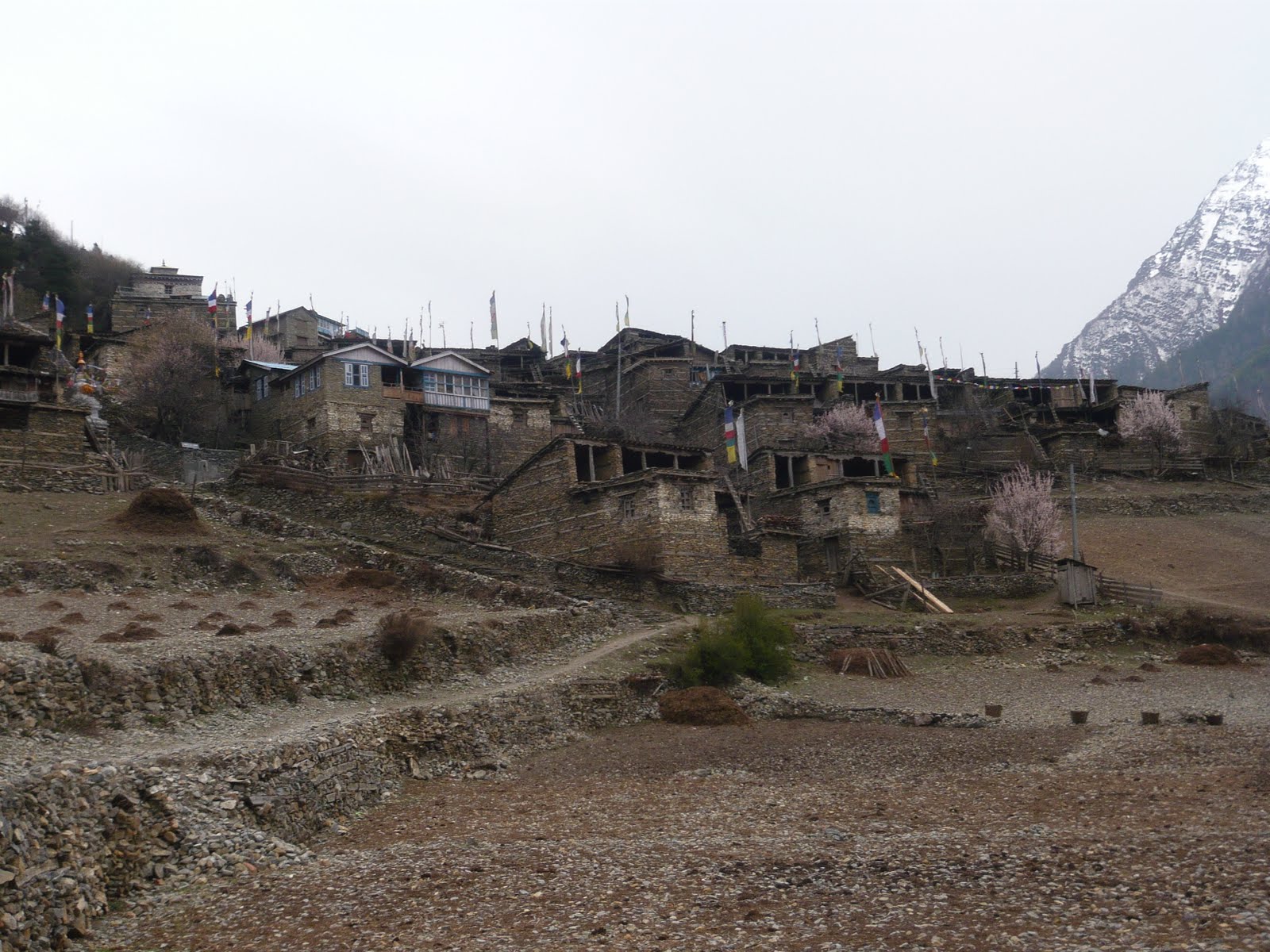
Upper Pisang

Graham the flea-ridden, poo eating mountain dog.

Tuesday, 3 May 2011

The Manaslu Circuit - Part 2

Day 8 - Samagaon (3530m) to Samdo (3860m) 3 hrs Good teahouse
We were woken up in the morning by Team National Parks of Australia getting out of there tents. Eventually dragging ourselves from our beds and looking out the window we were greeted with clear blue skies and stunning views of Manaslu. Soon the chatter outside was drowned out by the sound of a helicopter. It landed on the other side of the river and a woman from the Italian group was piggy backed out to it and whisked away. A sprained ankle probably but at this distance from the roadhead a helicopter evacuation was needed.

Apart from it being a beautiful day we also found that we had woken up in the year 2068. It was the Nepali New Year and they are a bit ahead of us.

After lots of photos we said our goodbyes to our Aussie trek-mates, as they were spending longer on the trek to do some side trips. We headed out of Samagaon along the muddy trail past an Indian Army team planning on climbing Manaslu itself. Being careful to take it slowly we crossed the Buri Gandaki for the penultimate time and were soon in the little village of Samdo for lunch.

James didn't feel that great in the afternoon so I climbed above Samdo on my own to aid acclimatisation. Samdo is close to the Tibetan border and here the passes to Tibet are still open to local trade. We were staying in the lovely Yak Hotel which had a cosy dinning room. That evening we sat around the stove with Team Europe (x4), Team Poland (x2) and half of the bossy Belgians (Lauren was sick) and chatted and laughed at our cultural differences.

James outside our room in Samagaon, the Australians tents in the foreground and the twin peak of Manaslu in the background.


Day 9 - Samdo (3860m) to Larkya Rest House (4480m) 2 1/2 hrs Resthouse tent
Still praying that the weather would hold we made a gradual ascent this morning through moraines. There was now no solitude on the trail as the many camping groups and their massive teams of porters and cooks all moved towards the one destination. We managed to get ahead of them and arrived at the ramshackled Larkya Resthouse in time to get the more comfortable tents rather than the drafty, half-derelict rooms.
Soon a sea of brightly coloured tents grew around us as the camping groups set up for the night.

James and I did a short acclimatisation walk in the afternoon where James managed to lose his warm hat luckily he had a spare as tomorrow we would have to start before dawn to cross the pass - but only if the weather held.


 Larkya Resthouse

Day 9 - Larkya Resthouse (4480m) to Bimtang (3720m) via the Larkya La (5180m) 7 1/2 hrs Very Basic Teahouse
We were very warm in our tent during the night so it was hard to get out of bed when the alarm went off at 3.30am.

Our head torches lit the way as we followed the trail through moraines and along the side of the glacier. The stars gave way to crystal blue skies with pristine mountain peaks everywhere. We gradually ascended from one false summit to the next.

At high camp we said goodbye to Team Poland who were planning to climb a peak from there. A Japanese team were already camped there. With all the different teams heading across the pass the scene resembled the retreat from Kabul. Keeping a steady, relentless pace, and despite leaving after everyone else (our guide, Gopal, doesn't like early starts), we got to near the front of the pack and could enjoy the mountains in relative peace. Finally the prayer flags which marked the pass at 5180m came into view - cue a lot of photos.

The descent was a lot more rapid, taking a route down some steep snow slopes. The porters, usually so sure on their feet, suddenly struggled in this unfamiliar terrain.

Bimtang looked idyllic from above, surrounded by crystal peaks and on a flat plain with a river running through it. This tiny settlement used to be a prominent trading post with reportedly up to 3000 pack animals in the 1950s. In the 1970s it became a hide out for Tibetan guerrillas. It hadn't seemed to have developed much since and amenities such as toilets were still absent. It was a case of lining myself up with a rock where the least amount of people could see me squat.

James, however, was very pleased with himself as we were the first team into Bimtang, and he announced that the Brits had won gold!

When the sun went behind the mountains we huddled around the fire in the kitchen. The stove had no chimney so the smoke filled the room then filtered through the roof. An Italian guide (Bronze position) who had struck up a relationship with her Nepali guide were also in the kitchen trying to have a quiet moment together.

Larkya La, 5180m, the high point on the Manaslu Circuit

The gold winning team, Gopal, James, myself and Nabaraj

Bimtang

Basic teahouse in Bimtang

Monday, 2 May 2011

The Manaslu Circuit - Part 1

Day 1 - Arughat (600m) to Khursane (820m) 6 hrs Basic teahouse. 
The trek begun by following a 4x4 track through Arughat and the rice paddies beyond. On the horizon was the 7000m peak of the Sringi Himal. There was little shade and we soon became hot and bothered. The trail followed the Buri Gandaki, a river which we would be walking beside for the next week. The valley narrowed during the day and we lost the views of the mountains.

Two intrepid trekkers (with silly sun hats) leave Arughat.

Day 2 - Khursane (820m) to Macha Kolna (900m) 5 hrs Good teahouse
Soon after Khursane the valley narrowed further into a gorge and the 4x4 track ended. The trail wound its way along steep forested slopes. The shade was welcome and monkeys could be seen through the undergrowth. The path climbed and dropped along the valley side eventually dropping to the river bed where we followed the sand bars for an hour or so, unprotected from the blazing sun.

In Macha Kolna a newly built teahouse awaited us and a trip to the hot springs in the afternoon was welcome.


Day 3 - Macha Kolna (900m) to Jagat (1410m) 7 hrs Basic teahouse
I felt sick all of today and could only manage a couple of mouthfuls of porridge in the morning. It was our first day of significant ascent (500m) so not a good day to feel ill. After Tatopani, which means hot water, and is named such due to the hot springs, we crossed the Buri Gandaki to its east bank for the first time. Here we got some relief from the sun.

Feeling nauseous and only being able to stomach Coke and a little water I was relieved to reach Jagat and the basic teahouse where we stayed. As I collapsed into bed the wind got up blowing clouds of dust up the valley and banging the bedroom shutters closed. After a rest I managed a light dinner, my first proper meal of the day.


Day 4 - Jagat (1410m) to Dyang (Deng) (1800m) 6hrs Teahouse under construction
Today we saw our first rhododendrons, red ones in the forest. Also plenty of monkeys. Unfortunately the teahouse we stayed in that evening was still being built (not very sympathetically) and was dusty and noisy.

Although I'd felt fine all day I started to feel ill again in the evening and couldn't manage much dinner. I had another virtually sleepless night and had just drifted off when some scrabbling woke me. A mouse had climbed onto my pillow and was watching me but soon ran off when I gave a very girly shriek - James didn't respond.


Day 5 Dyang (1800m) to Namrung (2660m) 6hrs Good teahouse
We had a great day today. I was now fully recovered and we followed the trail through a beautiful pine forest of huge mature pine trees and bamboo. We saw the summit of Manaslu for the first time and the mountain views became more and more spectacular throughout the day. We finished at an excellent, characterful and cosy teahouse, and spent the evening chatting to the 3 Australian park rangers who we had coincided with from the start of our treks and 2 bossy Belgium girls.

Other trekkers on the trail

A word about our guide and porter
So it wasn't just James and I on this trek we had employed a guide and a porter to help us. Gopal our guide was probably the tallest man in Nepal, at well over 6ft, and proved to be extremely strong and steady on his feet. He'd find everything hilarious. For example 'the French Canadians came into the dining room at 2.30am and we all had to get out of bed hahahahaha' ?! All the guides of the independent trekkers would work together to make sure we got a good bed for the night, taking it in turns to go ahead and reserve the rooms. So we were well looked after. Nabaraj was acting as our porter for this trek even though he was a guide. This was because he had not guided on the Manaslu Circuit before and wanted to take the opportunity to learn the route. Each evening he'd take notes on the days walk. He had a more normal Nepali stature and when he walked ahead of us it looked like our huge red bag just had two little legs attached to it.

Nabaraj, Gopal and porter in training, James.

Day 6 - Namrung (2660m) to Samagaon (3530m) 7hrs Basic teahouse
As we climbed today, more and more of the mountains revealed themselves, and the villages became more Tibetan. We left the 3 Aussie park rangers and 2 bossy Belgians at Lho to continue onto Samagaon and as we walked out of the gorge onto a plateau it started to rain. By the time we got to Samagaon it was pouring with thunder and lightening overhead.

Samagaon was a surprisingly large town cowering into the valley out of the elements. The paths were an inch thick in mud and yak poo and it was like stepping back into medieval times.

Our teahouse was pretty basic and we congregated around the fire in the kitchen. We joked about what energy efficiency rating our room would get as we could see light through the walls.

 James unimpressed with the weather

Day 7 - Rest day in Samagoan
It rained all night and in the morning the snowline had almost reached us. The dampness was penetrating and we still hadn't seen the mountains as the mist hung low in the valley. The Aussie park rangers and bossy Belgians had joined us by lunchtime when the rain turned to snow. We huddled closer to the fire in the kitchen. Food was of little comfort as even vegetables were running out and meals could only be described as having traces of vegetables. We had however gained yak's cheese which was delicious.

When the snow eased James and I walked up to the gompa which seemed virtually deserted.

Most worrying of all was the fact that if this weather set in it would be impossible for us to cross the pass and therefore continue on our trek. We hadn't contemplated this situation before we set out and it would be a disaster for our further plans of climbing Pisang Peak which we had already shelled out the hefty permit cost. If the weather continued we'd simply have to turn around and head back.

Samagaon in the rain / snow / slush / mud

Saturday, 30 April 2011

The Manaslu Circuit - An Intro

Arughat is the start of the Manaslu trekking circuit, a 16-18 day trek which circumnavigates Manaslu, the world's 8th highest mountain. Until recently this trek was solely a camping trek, involving being completely self sufficient. Camping treks can be quite an expensive and cumbersome way to trek as the amount of porters needed seems to increase exponentially with every trekker. However teahouses have been cropping up so now it is just about possible, if you are in a small group, to complete the circuit as a teahouse trek. Developing fast, the Manaslu circuit is tipped to be the new Annapurna circuit as trekkers are deterred from Annapurna due to all the road building taking place.


Manaslu stands at 8156m and was first climbed by a Japanese team in 1956. It has therefore always been thought of as a Japanese mountain and it continues to have ties with Japan. We saw some sacks of aid in villages marked with 'gift from the Japanese people'. The sacks were clearly quite old and unopened. We wondered if Japan would like them back for the moment!

Although trekking agencies still like to sell the Manaslu circuit as a camping trip it was a blog which first made us aware of the possibility of completing the trek as a basic teahouse trek. As this circuit is developing rapidly, that blog is now quite out of date, so I'll try to write about our experiences to give some more up to date information.

The first consideration when planning a Manaslu trek is that the Manaslu area is currently a restricted zone which requires an extra permit but this is easily acquired in Kathmandu. You are also meant to have a guide but we met a few people who just had porters. To do the trek staying in teahouses I'd recommend a group with a maximum of 4 trekkers (not including guides and porters) as there are some places which currently have very little accommodation. On the accommodation front you have to be prepared for a sometimes very basic standard. The rooms can be bare and sometimes the only food is Dal Bhat - vegetables were scarce and meat nonexistent. However, I think this adds to the experience and we enjoyed sitting in the smokey kitchens watching  family life go on around us. But if you want the same experience go now as it is changing fast.

A few other practical tips are that a 3 season sleeping bag is necessary as well as a thermarest or roll mat as sometimes the beds are very hard and cold. There was electricity in every other village, so charging of cameras etc is possible (sometimes for a small fee) and there is even internet at Samagaon. Simple food supplies like biscuits and noodles can be bought along the circuit but it is best to take your own means of purifying water rather than to rely on bottled water.

In my next installment I'll given a brief description of our trek on the circuit, hopefully for some light entertainment as well as giving some useful information for those wanting to do the trek themselves.